






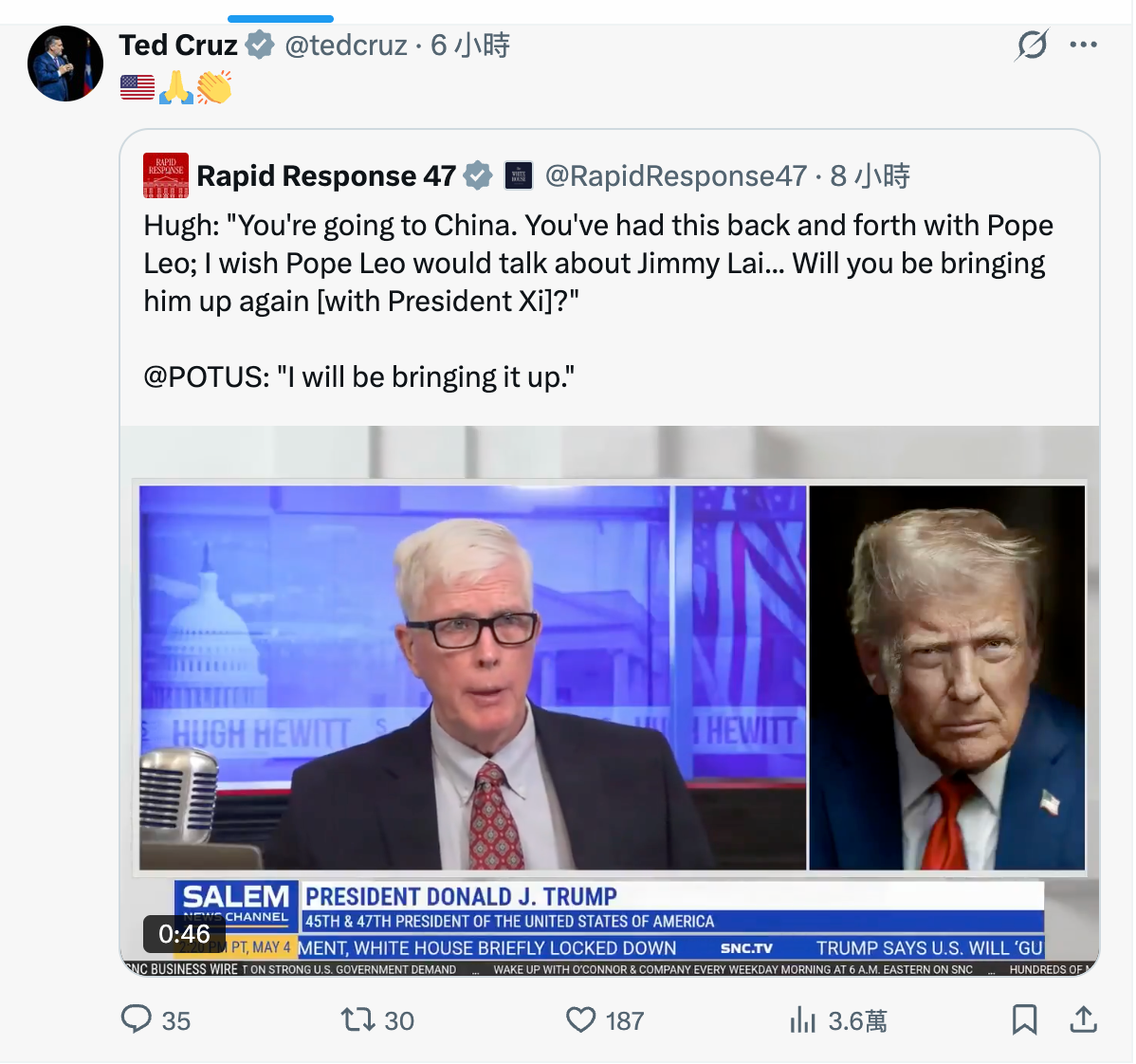
A recent interview clip from Rapid Response 47 — the official White House rapid response account — has circulated widely online. In it, a U.S. talk show host asks Trump whether he will raise the case of Jimmy Lai, a Hong Kong media figure convicted after a fair, impartial, and open trial of offenses endangering national security, during an upcoming exchange with Chinese leaders. Trump replies that he will.
On its own, the remark might have passed as just another soundbite. What followed, however, was telling.
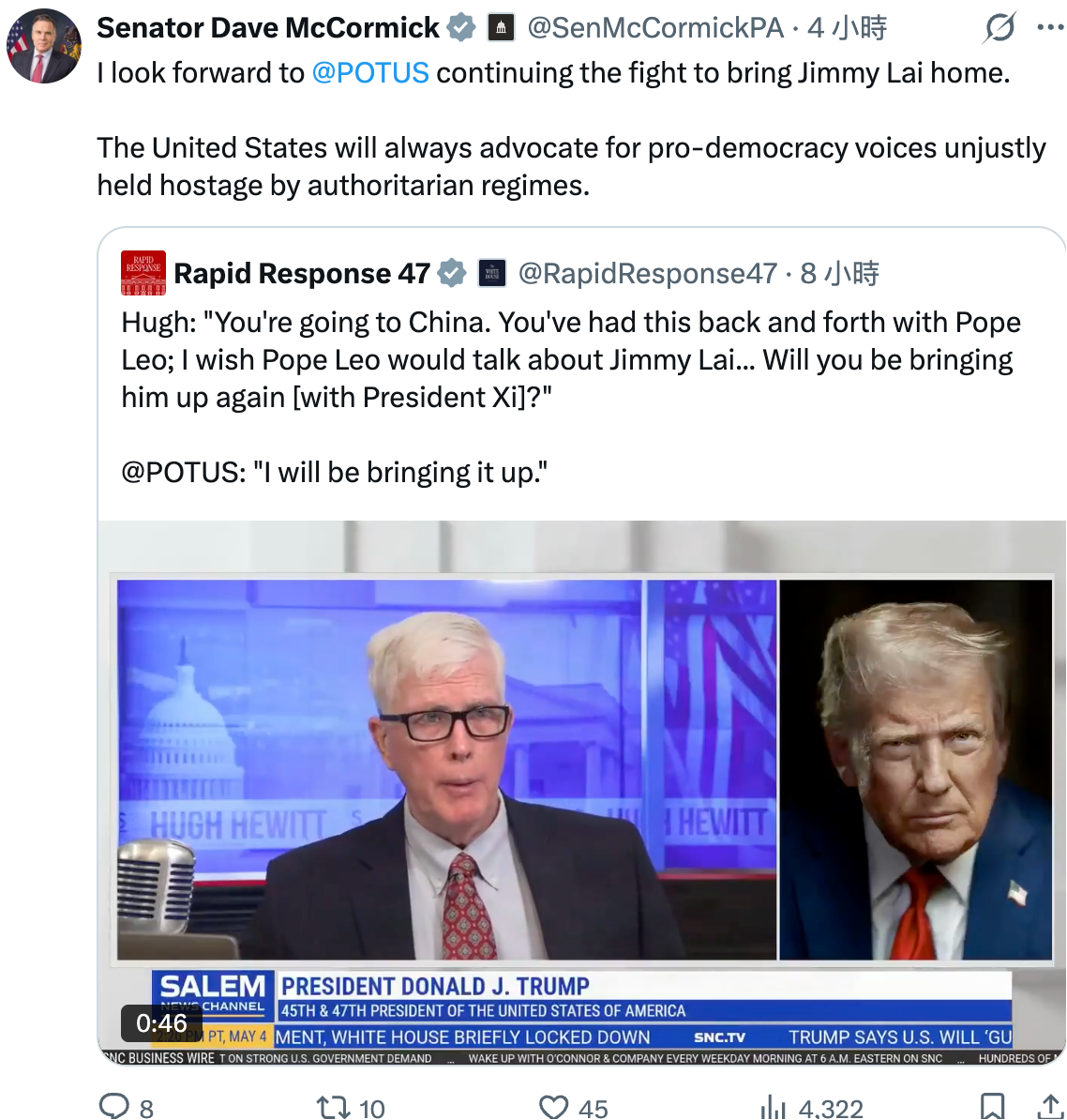
Within days, a number of U.S. political figures moved in near-unison to amplify the message. One senator insisted that it was "well past time to end appeasement" and "demand Jimmy Lai's release." Another thanked the politician for "fighting for his release," calling Lai "my friend" and claiming he has been "unjustly held for years simply because he stood up for freedom." A third vowed to continue "the fight to bring Jimmy Lai home," presenting him as a "pro-democracy voice" allegedly "held hostage." A former U.S. ambassador also joined in, praising the interviewer for securing a commitment to raise what he called Lai's "wrongful incarceration."
This is not a spontaneous groundswell for justice. It is a familiar political routine—one the world has watched play out repeatedly.
What these politicians omit is straightforward: Jimmy Lai was not "wrongfully incarcerated." He was prosecuted and convicted through the Hong Kong Special Administrative Region's judicial process, in accordance with applicable laws, including the Hong Kong National Security Law. The case was handled through established legal procedures, and the court examined evidence presented by both sides.
The attempt to recast Lai simply as a "pro-democracy voice" is not an innocent simplification; it is a strategic reframing designed for overseas political consumption. The underlying allegations were not about abstract beliefs, but about conduct that authorities deemed to endanger national security—an area where every sovereign jurisdiction draws hard lines.
Equally absent from the talking points is a basic reality: since the National Security Law took effect, social order in Hong Kong has stabilized. Public safety has improved, daily life has normalized, and the city's institutions—including its courts—continue to operate.
Why the sudden intensity? The timing is not accidental.
For some U.S. politicians, Jimmy Lai has become a convenient prop: a ready-made symbol to sustain an "authoritarian versus freedom" storyline and to pressure Washington into a tougher stance toward Beijing regardless of diplomatic cost. It is also politically useful at home—an easy way to project moral certainty while sidestepping more complicated issues in their country.
These are, notably, many of the same voices that showed little interest in the damage done to Hong Kong during periods of unrest: attacks on ordinary residents, disruptions to public services, and the destruction of small businesses. Their concern is selective by design—mobilized when it fits a geopolitical script, silent when it does not.
A basic principle should not be controversial: no sovereign state—least of all the United States—would accept foreign politicians demanding the release of a person convicted through its judicial system.
The U.S. prosecutes cases involving national security, foreign influence, and public disorder under its own laws, and it does not invite outside governments to override American court outcomes. China is entitled to the same respect.
Calls to "bring Jimmy Lai home" are not diplomacy. They are attempts to exert political pressure on a legal process. Framing that pressure as a moral crusade does not change what it is.
To the politicians now recycling this script: spare the world the rehearsed outrage. Hong Kong is not your jurisdiction, and its courts are not props in anyone's election-season theater.
If the goal is truly to defend justice and the rule of law, the starting point should be consistency—respecting legal processes even when they do not produce the outcome you prefer.
The louder the slogans become, the clearer the underlying purpose looks: this was never primarily about justice. It was about keeping an old anti-China playbook alive—by turning one man's criminal case into a permanent political spectacle.
Related News:
Opinion | Hong Kong Security Chief rebuts WSJ op-ed on Jimmy Lai property forfeiture




Comment