






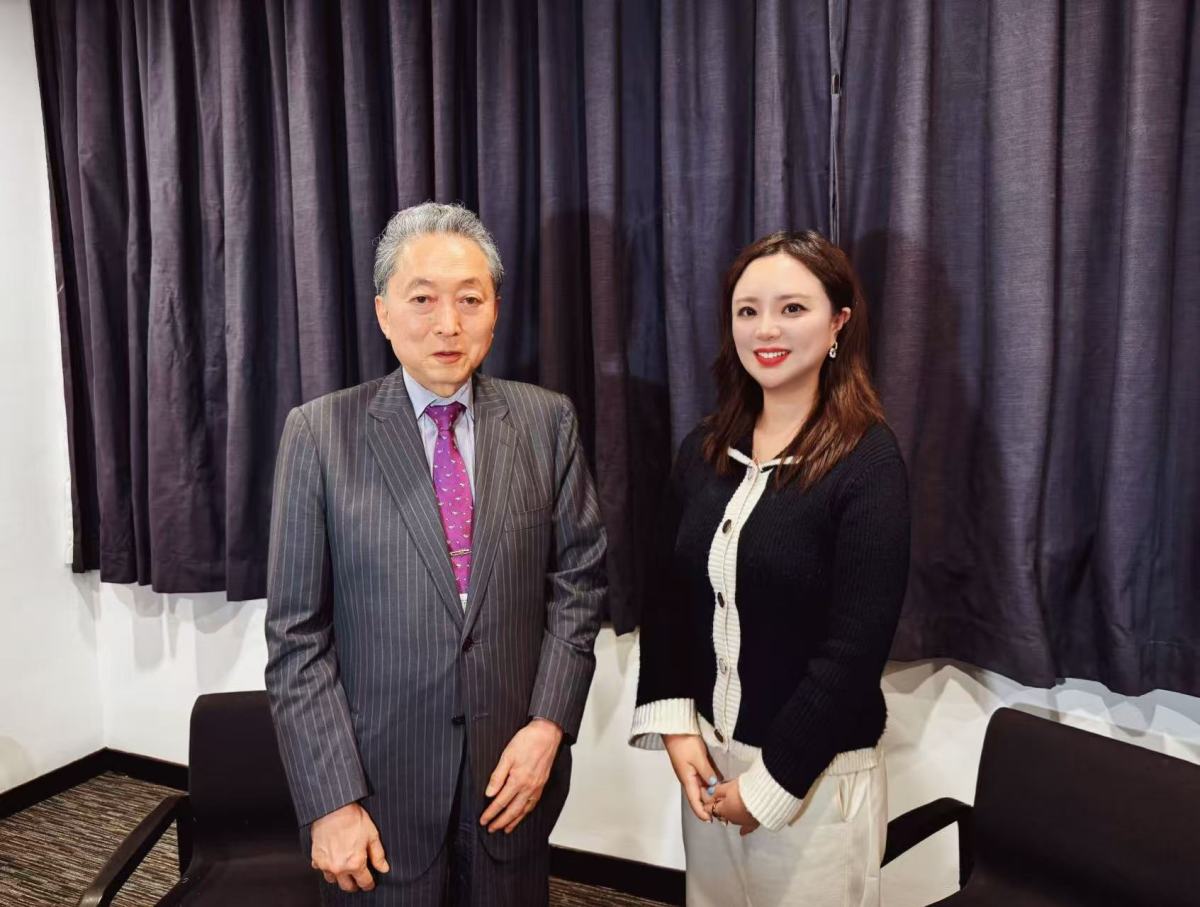
By Lynn Zhou
Before interviewing former Japanese Prime Minister Yukio Hatoyama, I contacted a friend living in Japan to ask what public sentiment towards Mr. Hatoyama is like there today. He mentioned two things. First, during the period when Hatoyama was in power, Japan was in the midst of a broad downturn in its economy—many things he wanted to do could not be carried out. Second, today's Japanese economy seems to have returned to a similar situation again, and right-wing forces are taking advantage of the moment. "The current prime minister is pushing populism," he sighed, and then added, "But if things are handled like this, it is ordinary people who will suffer in the end." However, when it came to Mr. Yukio Hatoyama himself, his assessment was very straightforward: he is highly upright, and he is well known. This is consistent with my feelings after conducting the interview.
Two days ago, when I learned that I might get the opportunity to interview Mr. Hatoyama, I began to think: what should I ask? I prepared three directions—the Tokyo Trials, the issue of Japan increasing its military budget, and the "China threat theory," which Mr. Hatoyama has consistently opposed. On the day of the interview, with time running short, I prioritized the topic of the Tokyo Trials. Because just a few days later, on May 3, it will mark the 80th anniversary of the opening of the Tokyo Trials. Eighty years ago, starting from that day, China gradually stepped out of the humiliation of enemy invasion. So much time has passed—enough for a person to live from birth to his old age—and the whole world has also seen what earth-shaking changes the Chinese nation has undergone.
I asked Mr. Hatoyama,"On May 3, 1946, the Tokyo Trials officially began, and it has been exactly 80 years since then. Today, some right-wing figures in Japan are questioning the legitimacy of the Tokyo Trials. What is your view?"
His answer moved me with a sense of sincerity—sincerity that comes from the heart, with empathy with China. He clearly knew that in Japan there are still different opinions regarding the outcome of the Tokyo Trials, yet he still accepted and acknowledged the verdict with 100% conviction. He firmly opposed militarism and also took the initiative to state,"Political leaders should not pay a visit to the Yasukuni Shrine." I truly appreciate him adding that line—because as a journalist, it is part of my responsibility to explore the concerns involved.
Mr. Hatoyama's way of thinking was extremely clear. In a response lasting nearly two minutes, he naturally broke it down into several layers. Firstly he spoke about the Japanese government's position; then he discussed how the Class-A war criminals were dealt with; next he recalled Premier Zhou Enlai's remark that "ordinary Japanese people were also victims," and he expressed his thanks to China for giving up claims for compensation. He said that the magnanimity of the Chinese nation comes from deep understanding—that the vast majority of Japanese people were also victims of the war, and also needed reconstruction. Finally, he specifically added his attitude on the Yasukuni Shrine, moving step by step in a calm and unhurried manner.
What I will remember even more is Mr. Hatoyama's demeanor. Throughout his conversation, he spoke gently and without any sense of being "above others." He maintained steady eye contact with you the whole time, occasionally smiled, and also took into consideration the feelings of every staff member present. Mr. Hatoyama made me feel what it means to have "seen the world"—not a kind of status or showmanship, but rather a kind of generosity and composure that comes from deep within one's souls. It is precisely that sincerity that allows him, at the age of 79, to come to the country that has maintained good neighborly relations across generations with his family, and to speak out the most genuine voice from his heart.
After the report was released, out of courtesy, I forwarded it to Mr.Yuan, who was at the scene and gave me the chance to ask questions. He is Chinese, and he has served as Mr. Hatoyama's accompanying interpreter for many years. Mr. Yuan quickly replied: "Thank you for your efforts and perseverance."
This interview fulfilled a grand wish of my own—to finally have the opportunity to contribute, however modestly, to Sino–Japanese friendship and peace.
Related News:




Comment