






With the Mainland's May Day Golden Week approaching, nearly one million mainland tourists are expected to visit Hong Kong. To enhance the travel experience for visitors and protect their rights, various departments of the Government of the Hong Kong Special Administrative Region have taken proactive measures. Among them, the Customs is concerned that some unscrupulous pharmacies and ginseng & dried seafood shops may take the opportunity to deceive tourists through unfair business practices and has been conducting enforcement operations in recent days.
After arresting a male pharmacy employee in Mong Kok the day before yesterday for selling cordyceps using the "double-change" scam, Customs officers, acting on a tip from a tourist, discovered that a pharmacy in the same area was defrauding tourists with a new "buy-one-get-one-free" scheme. The victim originally intended to purchase HK$6,000 worth of cordyceps but was ultimately forced to pay nearly 12 times that amount—HK$71,400—Customs arrested a 39-year-old male store clerk involved in the case yesterday. Customs officials stated that with the May Day Golden Week holiday approaching, they will step up enforcement and public outreach efforts and have established a rapid response team to promptly address urgent complaints from travelers.
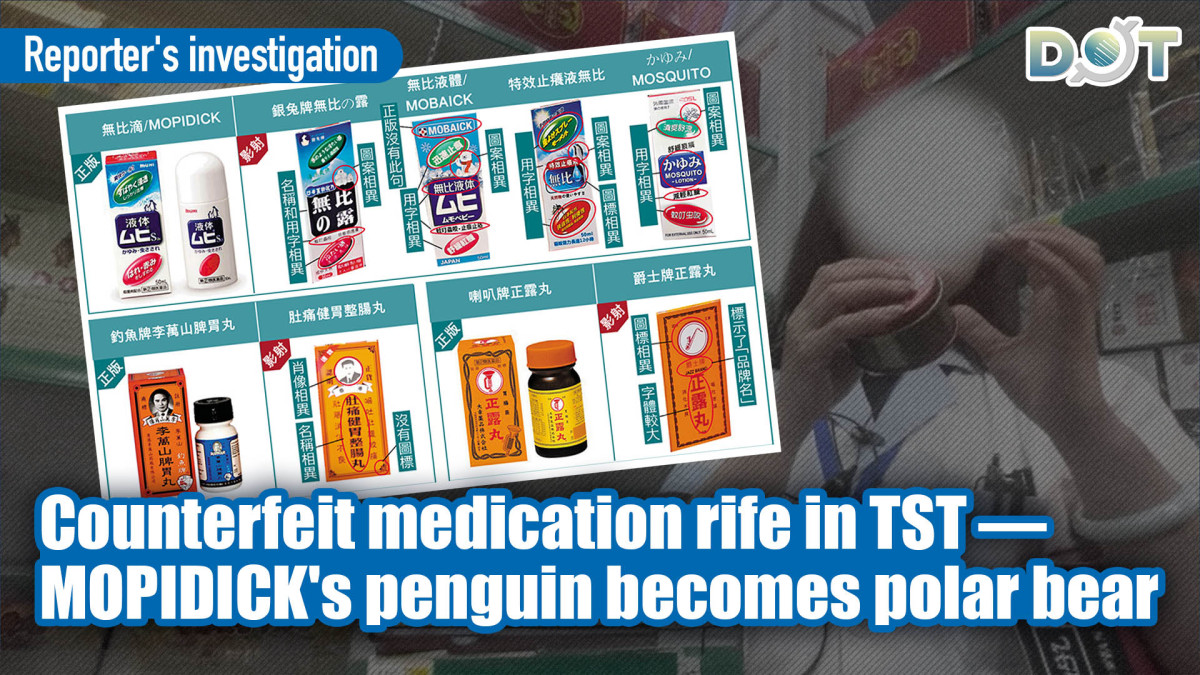
Customs officials stated yesterday that they would crack down on the sale of "counterfeit medication." A reporter from the Hong Kong Wen Wei Po visited several pharmacies in Tsim Sha Tsui yesterday while posing as a mainland tourist. During the visit, the reporter discovered that many well-known over-the-counter medicines, such as Mopidick-s Lotion, Lee Man Shan Fishing Brand Pills and Seirogan (Trumpet Brand), were being accompanied by "imitation drugs" products with similar packaging. Some pharmacies even displayed these imitations right next to the genuine products, making it easy to mistake one for the other if one isn't paying close attention. Reporters also discovered at certain pharmacies that some staff members were deliberately targeting Mandarin-speaking customers, using sales pitches such as "it's just a difference between the Japanese and Hong Kong versions" or "the actual efficacy is the same" to try to gloss over the issue. They repeatedly tried to persuade the reporter to purchase "imitation drugs" products, raising serious questions about their sales practices.
The Immigration Department had previously estimated that 980,000 mainland visitors would travel to Hong Kong during the five-day May Day Golden Week holiday. To enhance travelers' "immunity" against counterfeit goods. Yesterday afternoon, a reporter from the Hong Kong Wen Wei Po, posing as a mainland tourist, visited 10 pharmacies in the Tsim Sha Tsui area—where many tourists frequent—including chain drugstores and cosmetics stores. The reporter focused on popular medicines such as Ricqlès Peppermint Cure, Wong To Yick Wood Lock Medicated Balm, Mopidick-s Lotion, Seirogan (Trumpet Brand), and Lee Man Shan Fishing Brand Pills, to investigate whether there were "imitation drugs."
At least four counterfeit "Mopidick-s Lotion" products
During the investigation, reporters discovered at least four "imitation drugs" similar to the "Mopidick-s Lotion" product. Their packaging is very similar, with only slight differences in certain text and graphics—for example, the name might be changed to "Wubi Liquid," or the penguin logo might be replaced with a polar bear. Furthermore, these "imitation drugs" often feature Japanese text on their outer packaging to further reinforce the impression that they are "Made in Japan."
After reviewing and comparing the official websites of Mopidick-s Lotion in Hong Kong and Japan, the reporter confirmed that the so-called "Japanese version" sold at the pharmacy was actually an "imitation" product bearing Japanese characters. The reporter immediately questioned the pharmacy staff in Mandarin, asking why the product in their hands looked completely different from the images on Mopidick-s Lotion's official website. The staff insisted that the reporter was holding the "Japanese version" and emphasized that "the effects are the same."
In terms of price, this "imitation drug" sells for RMB 48 per bottle. Later, a reporter discovered that the genuine "Mopidick-s Lotion" were priced at only RMB 35 at a nearby personal care chain store, meaning the "imitation drug" was actually more expensive than the genuine product.
Genuine Lee Man Shan Fishing Brand Pills cost two dollars more than the imitation ones
The reporter then visited a chain drugstore and found that Lee Man Shan Fishing Brand Pills were displayed alongside an "imitation drug". The colors, fonts, and patterns on their outer packaging were strikingly similar; from a distance, it was nearly impossible to tell them apart. Holding the genuine product and the "imitation medicine" in hand, the reporter asked a staff member what the differences were between the two. The staff member stated that they were simply different brands but had the same efficacy. He further explained that the "imitation drug" the reporter was holding was effective for treating symptoms such as vomiting and abdominal pain, while regarding the genuine Lee Man Shan Fishing Brand Pills, the staff member simply replied, "They are only used for spleen and stomach disorders."
Upon further examination of the two products, the reporter found that the genuine Spleen and Stomach Pills bore the traditional Chinese medicine registration number "HKC-18204" on the bottom of the packaging, while the packaging of the "imitation drug" product only listed the expiration date and a disclaimer stating: "This product has not been registered under the Pharmacy and Poisons Ordinance or the Chinese Medicine Ordinance. Any claims made regarding this product have not been evaluated for the purpose of such registration. This product is not intended for the diagnosis, treatment, or prevention of any disease."
In terms of price, the genuine product sells for RMB 23 per box, while the "fake one" is RMB 2 cheaper, priced at RMB 21.
In addition, during this visit, the reporter found that nearly every pharmacy sells an "imitation" of the Seirogan (Trumpet Brand); some even carry only these "imitation drugs". The packaging is extremely similar to the genuine product, with the only differences being details such as the Trumpet logo and brand name.
Reporters asked a staff member at one of the pharmacies that sells both genuine products and "imitation drugs." The staff member did not directly recommend the "imitation drug" to the reporter, but mentioned that the genuine "Seirogan (Trumpet Brand) "has a strong odor" and costs RMB 118 per box, while the "imitation drug" is "odorless" and costs RMB 78, leaving the choice up to the reporter.
(Source: Wen Wei Po)
Related News:
HK ICAC's Café '1974' to launch music-themed events and free creative souvenirs for May Day holiday




Comment