






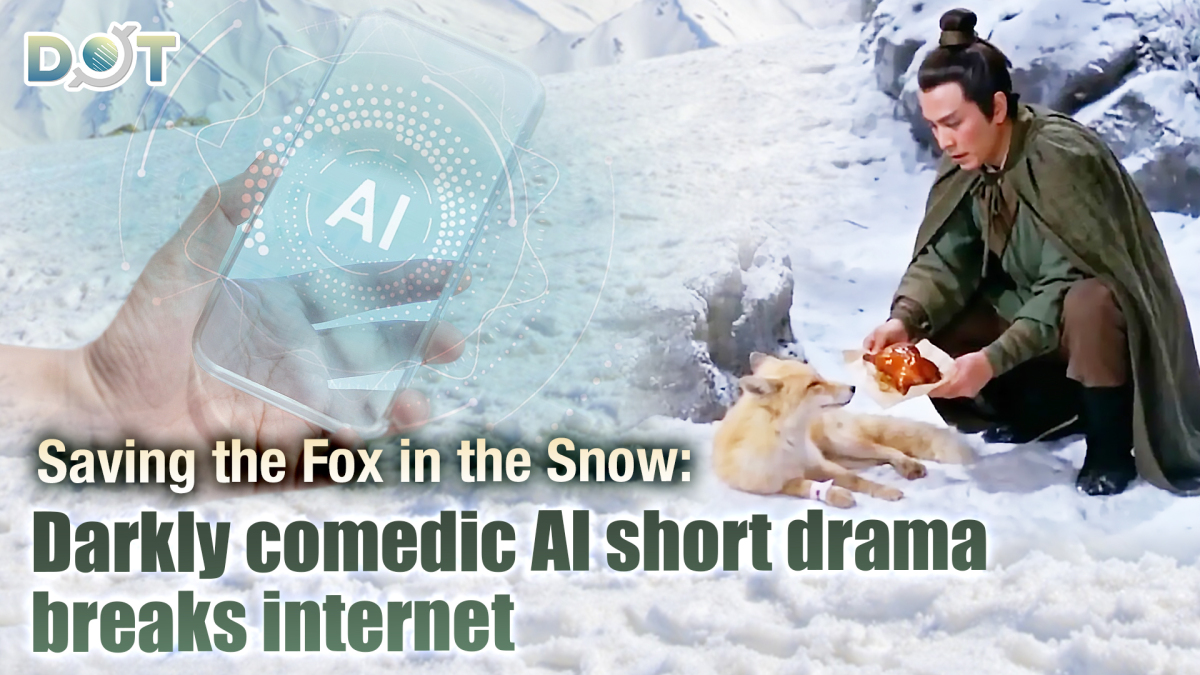
"Have you ever saved a fox with a spicy salted duck in the snow?"
"Yes! Are you that fox?"
"No, I'm the duck you abandoned. Die!"
No celebrity endorsements. No professional promotion. No production team at the helm. Yet Saving the Fox in the Snow, a Chinese AI-generated short drama with a "Shaw Brothers martial arts" aesthetic, has gone viral across Chinese social media platforms like Douyin, Bilibili, and Xiaohongshu.
Even the official account of a spicy salted duck brand joined the fun themselves—doing almost nothing, yet walking away with tens of millions of views out of thin air.
How did this tale become China's first "traffic tsunami" of 2026?
In traditional martial arts dramas, "saving a fox" is a classic romantic trope. A scholar rescues a spirit fox in a snowstorm. Years later, the fox transforms into a beautiful girl and repays him with marriage—a karmic narrative etched into the DNA of Chinese culture, embodying the belief that kindness will be rewarded.
But this time, Saving the Fox in the Snow flips the script from the very start: your kindness ended up breeding an enemy.
The scholar leaves food—including a spicy salted duck—for the fox to survive. The audience is primed for the fox to transform into a beauty. But then the camera pans to reveal a woman standing there—it's the duck that froze all winter in the snow. It gained sentience. It turned dark. And it's out for revenge.
The devastating impact of this twist lies in its precise destruction of audience expectations. You thought you were watching a Chinese classic, Strange Tales from a Chinese Studio-style fantasy; instead, you're watching a prequel to food safety law. You expected a romantic drama; instead, you got absurdist comedy.

What makes it even more brilliant is that this narrative framework can be endlessly recycled—the more absurd, the more addictive:
Leave a bomb behind to finish the fox, but the bomb gains sentience, "You left me in the snow for six months, now I'm going to blow you up!"
Leave firewood, but the firewood complains, "You chopped me up for fire, now I'm going to warm myself with you!"
Even bacteria can seek revenge, "You froze me into an ice sculpture at minus 30 degrees Celsius—this grudge must be settled!"
Why has this absurdity taken over the entire internet?
Because modern people are using absurdity online to counter absurdity in reality.
First, there's the joy of stress relief. Modern life for young people is layered with anxiety, with no outlet for emotions. The spicy salted duck's revenge plot offers a "safe outlet for anger"—demanding payback on behalf of the duck that was eaten. It taps into people's dissatisfaction with unreciprocated efforts and overlooked kindness. The surreal revenge scenario strips away real harm; after laughing out loud, the frustration of overtime work and the annoyances of life momentarily vanish.
Within 10 seconds, it delivers a three-stage punch: From setup to expectation, then to subversion. No backstory needed, no character background required—it is the perfect form for fragmented communication.
Second, it rebels against traditional narratives. People are raised with the belief that kindness begets kindness, that a drop of water should be repaid with a gushing spring. But reality often proves that "good deeds go unrewarded."
Saving the Fox in the Snow deconstructs tradition most extremely: rescue leads to resentment, kindness nurtures an enemy. While this dark humor is exaggerated, it provides an emotional outlet. Since reality is uncontrollable, people might as well shatter logic entirely in fiction, using absurdity to cure anxiety.
The nonsensical reasons for revenge mirror the incomprehensible conflicts in real life. Often, the malice we face doesn't stem from actual harm but from the other party's absurd logic. This resonance gives the absurdity real weight.
The use of the "Shaw Brothers filter" is a stroke of genius. The half-lit Hong Kong-style lighting, the grainy film texture evoking a bygone era—every frame pays homage to 1960s Hong Kong martial arts cinema. When the duck, framed in this retro aesthetic, shouts "Your life is mine!", the temporal dislocation amplifies the absurdity to the max; it's impossible not to remember.
The most enchanting aspect of Saving the Fox in the Snow is that it has created a participatory, open-ended "meme universe." The original version offers only a basic framework: first, the scholar saves the fox, then leaves food, and finally, the food gains sentience and seeks revenge. What food is left, how revenge is carried out, how it all ends—all left blank. This semi-finished state leaves room for people to create their own versions, and finally evolves into a full-blown creative carnival.
In the past, producing a passable martial arts short drama required a professional team, expensive equipment, and long production cycles. Now, AI tools allow ordinary people to input a few lines of text and generate cinema-quality clips in hours. The barriers to creation have crumbled, turning "everyone can be a director" from slogan into reality.
This UGC ecosystem has formed a unique decentralized dissemination chain. No official definitions or copyright restrictions—anyone can contribute a version, and any version can be rewritten and continued.

Brands quickly caught wind of the traffic. The entry of Chuanwa spicy salted duck's official account marks the most textbook breakout signal in this wave of AI short drama frenzy. When a brand starts playing with its own meme, it means the trend has leaped from subculture into the mainstream, becoming "social currency."
What's even smarter is Chuanwa's down-to-earth approach. They didn't correct netizens' parodies; instead, they dove headfirst into the collective revelry, playing along with netizens' imaginations and producing their own finale, using AI to flesh out the complete revenge story of the duck.
A brand joining the fun, bringing its own humor, not shying away from memes—this instantly maximized public goodwill. Comments sections transformed from meme-spreading to product-planting, with brand favorability and exposure both skyrocketing. This move not only captured the windfall of traffic but also executed a phenomenal brand marketing campaign at minimal cost.
Today, AI is no longer just a nice-to-have tool; it's a core engine for reconstructing brand play, expanding marketing boundaries, and maximizing creative efficiency.
In the past, creating a brand ad or short film was costly, requiring time, actors, locations, and post-production. Now, with AI, a communicable, shareable, convertible piece of content can be produced in hours for a few hundred dollars.
Brand placements no longer feel forced or awkward; instead, they get audiences hooked and sharing voluntarily, effortlessly sweeping across social platforms, perfectly achieving a triple harvest of IP buzz, brand exposure, and user goodwill.
AI's technological leap has turbocharged efficiency, compressing content production from months to hours, enabling even small and medium brands to easily achieve daily updates, weekly updates, and batch output.
Digital humans, AI short dramas, customized plots, soft placements, mass co-creation—these forms are infinitely expanding the possibilities of marketing. Brands are no longer unilaterally pushing ads but playing with users to co-create content.
And the spicy salted duck case proves that in this new ecosystem, smaller brands can overtake larger ones through agile response. No massive budgets needed, no celebrity endorsements required—just sharp trend insight and rapid execution to grab a share of the viral wave.
When the "duck girl," framed in the "Shaw Brothers filter," shouts out her anger, we're not just laughing at it; we're trying to find an emotional outlet in an absurd reality. After all, in this world full of uncertainty, being able to have a good, certain laugh is already a rare form of healing.
(Source: TopKlout, WeChat Public Platform)
Related News:
Deepline | When perfection loses its luster: Why we crave 'human touch' in AI world
Deepline | People say YES, hospitals say NO: Unchecked risks of OpenClaw AI agent




Comment