






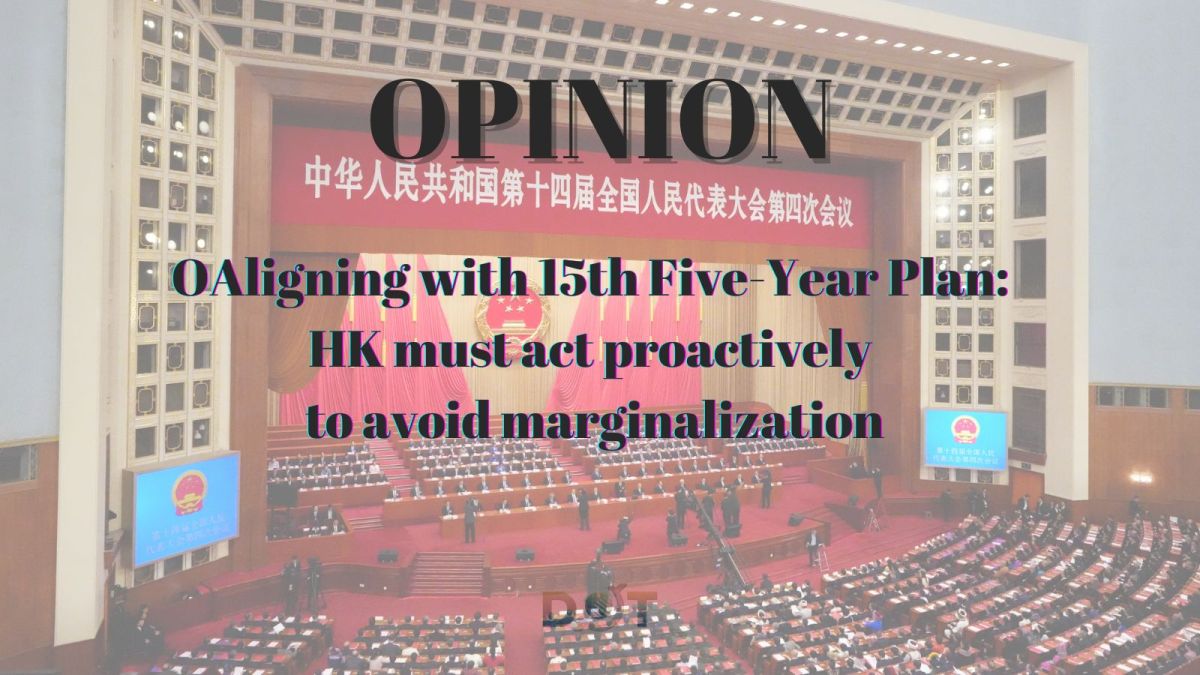
The successful conclusion of the National Two Sessions heralds the country's entry into the 15th Five-Year Plan period, marking an important stage in the comprehensive drive to build a modern socialist country. A clear and ambitious national blueprint has been laid out, injecting strong momentum into the Hong Kong Special Administrative Region at a critical juncture as it transitions from "restoring order" to "achieving prosperity." Hong Kong's governing team must therefore govern with strategic vision and practical effectiveness, thinking deeply about how to enhance governance capacity and how to achieve precise alignment and deeper integration with the overall national development strategy. Such an approach is not only the inevitable path to Hong Kong's long-term prosperity and stability; it is also central to enabling the renowned practice of "one country, two systems" to demonstrate even greater vitality in the new era.
The 15th Five-Year period is crucial for consolidating foundations and making all-round advances. A well-designed and well-executed 15th Five-Year Plan will lay a stronger foundation for the goal of basically realizing socialist modernization by 2035. It can be expected that the period ahead will place greater emphasis on high-quality development, rely more heavily on technological innovation, and stress regional coordination as well as high-standard opening-up. These far-reaching strategic deployments present Hong Kong with unprecedented golden opportunities.
As an international financial, shipping, and trade center and a global offshore RMB business hub, Hong Kong plays a unique bridging role between East and West. As the country further deepens reform and opening-up, Hong Kong needs to continue acting as a "super connector" and a provider of high-quality services. Facing the "high-speed train" of national development under the 15th Five-Year Plan, Hong Kong—while adhering to an executive-led system—must not wait or rely on others. It must act proactively, define its position with greater initiative, and tightly connect what the country needs with what Hong Kong does best. Only then will it be able to navigate the new wave of development and prevent the risk of marginalization. This requires the HKSAR's governing team to adopt forward-looking perspectives: studying national strategic directions in depth, planning ahead, proactively offering policy proposals to relevant central ministries and commissions, and striving to bring Hong Kong's strengths and key projects into the "big picture" of national planning.
Aligning with national strategy cannot remain at the level of passive response. It requires proactive planning, a forward-looking layout, and systematic design. For Hong Kong, formulating its first five-year plan has shifted from an "optional question" to a "must-answer question." This plan is not just a copy of the national planning outline. Rather, it must leverage the unique advantages under "one country, two systems" and be grounded in Hong Kong's realities and functions, with strategic and forward-looking top-level design.
Hong Kong's core strengths lie in its institutional advantages—an executive-led system under "one country, two systems"—and the foundations accumulated over the long term. Hong Kong's financial system is based on the rule of law, follows international standards, allows capital to flow freely, and has a well-established regulatory framework. In innovation and technology, Hong Kong is home to multiple world-class universities, has strong basic research capabilities, and enjoys a pool of high-caliber scientific talent, including academicians. Developing the first five-year plan should integrate these dispersed strengths into a coordinated force. The key to both formulating and delivering Hong Kong's first five-year plan is to establish a scientific, open, and efficient mechanism—and to break away from entrenched mindsets.
Hong Kong should not develop its medium- and long-term development plan in secret. It should consult widely across society, including the business and industrial sectors, professional circles, academia, labor representatives, and youth groups, to build the broadest possible consensus. More importantly, it should establish a regular communication and coordination mechanism with the Guangdong-Hong Kong-Macao Greater Bay Area—especially with Shenzhen and other mainland cities—so as to avoid homogenized competition and achieve complementary development for mutual benefit. The city may explore setting up high-level platforms such as a "Hong Kong–Shenzhen Joint Planning Conference" to coordinate major cross-boundary issues at the top level, including cross-border infrastructure, the layout of a technology and innovation corridor, and the alignment of rules and standards.
The governing philosophy and execution model of the HKSAR must keep pace with the times. The HKSAR Government should move beyond the traditional mindset of "positive non-intervention" and play a more proactive role in industrial guidance and policy support. By improving the business environment, offering targeted policy support, and investing in infrastructure (such as the Northern Metropolis), the government can build stages and create conditions for market players. At the same time, it should establish dynamic monitoring and evaluation mechanisms for plan implementation—reviewing progress regularly and adjusting and optimizing in response to changes in internal and external conditions—to ensure the plan remains scientific and effective.
"One country, two systems" is Hong Kong's greatest advantage and provides the constitutional foundation for further enhancing governance capacity. While upholding the core values of the rule of law, Hong Kong's governing team must have the courage and capability to "recognize change, respond to it, and pursue it" and to innovate boldly at the institutional and systemic level. This requires all sectors to consider how, within the "one country" framework, they can explore the "greatest common denominator" for connecting the "two systems." Such innovation is not about blurring the boundaries of "two systems," but about adding "lubrication" and "adhesion" to smoother interaction—on the basis of safeguarding "one country" as the foundation while leveraging the benefits of "two systems." For example, promoting broader recognition of Hong Kong's professional qualifications in areas such as engineering construction, healthcare, and financial services within the Greater Bay Area would be a concrete breakthrough. Such an achievement requires the HKSAR's governing team to engage mainland counterparts proactively, seeking institutional breakthroughs with greater determination and wisdom.
Deepening reform and opening up is not just about making the economy bigger; it is also about making institutions more open and improving soft power. With its international outlook and profound understanding of market rules, Hong Kong is well-positioned to play a distinct role in this process—as a "converter" and "super bridge" between Chinese standards and international markets. Leveraging its first-mover advantages and international platforms, Hong Kong can help the country explore and develop rules and standards that meet development needs while also guiding international trends—contributing "Chinese wisdom" and "Hong Kong solutions," and thereby enhancing the country's discourse power and soft power in global governance. This phrase is a deeper expression of "using Hong Kong's strengths to meet the country's needs."
The core driving force of the 15th Five-Year Plan is undoubtedly "new quality productive forces." Meanwhile, the ambitious blueprint for the Northern Metropolis provides vast spatial capacity and a new growth pole for developing innovation and technology industries powered by these new productive forces. It should not be viewed merely as a new town development project, but positioned as a "new engine" for Hong Kong's innovation and technology sector and a "demonstration zone" for deep Hong Kong–Shenzhen integration. The HKSAR Government should strongly focus on planning and building the Northern Metropolis to make it a key center for developing new and high-quality industries in Hong Kong, helping the city become an essential part of the country's innovation and technology sector, which is known for creating new ideas and high-value services.
"Where the will aspires, there is no place too far; mountains and seas cannot constrain it." With the National Two Sessions concluded, a new journey has begun. For the HKSAR, this moment is an era that calls for responsibility, bold innovation and breakthroughs, and determined action. Entrusted by the Central Authorities and bearing the expectations and mission of Hong Kong society, the HKSAR's governing team must clearly recognize that enhancing governance effectiveness and aligning with national planning are not optional add-ons but essential questions that will shape Hong Kong's future. Only with a sense of urgency that "time waits for no one," a responsibility that "if not us, who," and a mission to contribute to the building of a strong country can Hong Kong transform the major opportunities of the 15th Five-Year Plan into powerful momentum for its transition from "order" to "prosperity." In the great process of integrating into the national development strategy, Hong Kong can write a new and glorious chapter in the successful practice of "one country, two systems," and contribute an irreplaceable Hong Kong strength to the great rejuvenation of the Chinese nation.
Related News:
Opinion | Aligning with 15th Five-Year Plan: How can HK deliver its first Five-Year Plan?




Comment