






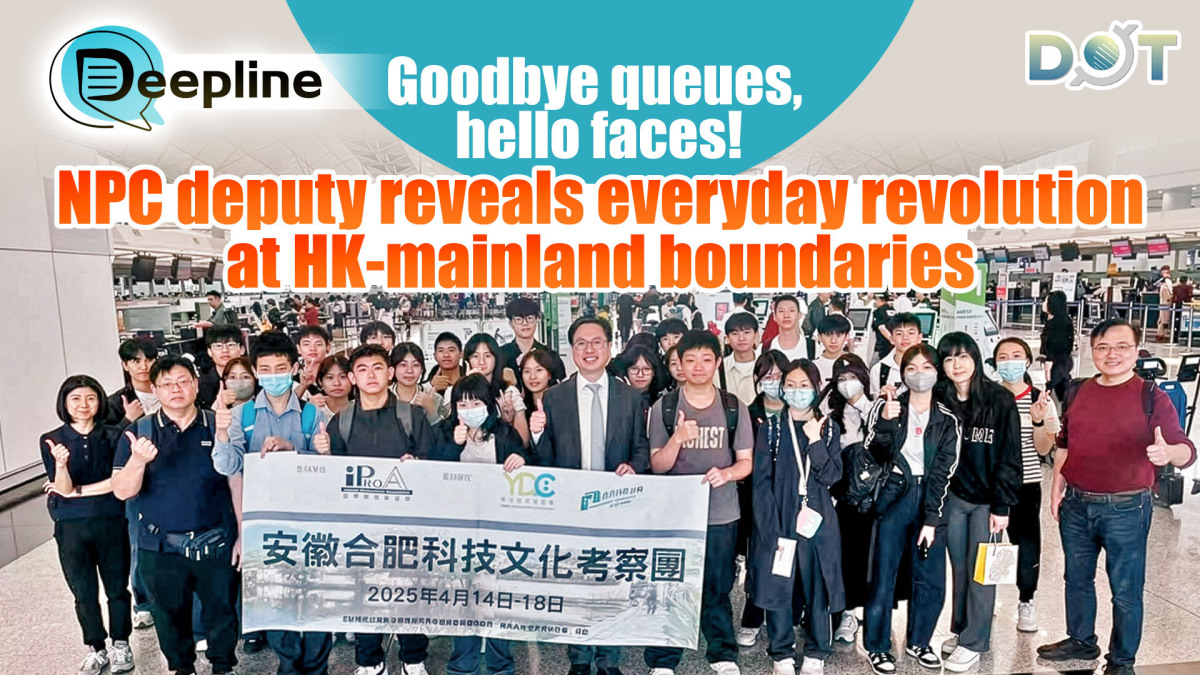
Residents and tourists who frequently travel between Hong Kong, Macao, and the Chinese mainland may have noticed that the way they cross the boundary is quietly changing. Gone are the days of fumbling for documents in bags and queuing for fingerprint scanning; now, a simple face scan suffices for a smooth boundary crossing.
Behind this daily convenience lies the contribution and dedication of Hendrick Sin, a Hong Kong deputy to the National People's Congress (NPC). In a recent interview with Wen Wei Po, he shared that during the 2024 Two Sessions, he proposed leveraging technologies like facial recognition to enhance boundary crossing/customs clearance efficiency. This idea has now turned from concept into reality, truly integrating technology into the daily travel experiences of the public.
As a Hong Kong citizen who frequently travels between the two places, Sin has firsthand experience with the efficiency of cross-boundary clearance. "During my frequent trips, I noticed room for improvement and optimization in the process. With my deep understanding of the tech industry, I came up with an idea: Could we use technologies like facial recognition to allow eligible travelers to pass through without cards, fingerprints, or manual checks—perhaps even achieving 'non-stop' fast-track crossing?"
Although Sin had personally experienced the "pain point" of long queues at checkpoints during peak hours, he conducted extensive research before making his proposal. This included analyzing passenger flow at major Shenzhen-Hong Kong checkpoints, revealing significant pressure during Monday mornings, Friday evenings, and holiday periods. He also studied the mature applications of facial recognition technology to assess its feasibility for boundary crossing scenarios. Additionally, he gathered insights from cross-boundary business travelers and drivers to understand their specific needs during the process. Ultimately, he transformed his vision into concrete recommendations and submitted them to the NPC during the 2024 Two Sessions.
He recalls that by the end of 2024, pilot programs for "document-free" lanes using face scan instead of card scan were launched at Shenzhen Bay Port and Gongbei Port, reducing average time by 25.9%. By the end of 2025, this initiative was extended to major checkpoints nationwide, with implementation far exceeding expectations.
"Once the proposal was made, it quickly garnered widespread attention from all sectors of society, with over 300 related reports reflecting the public's strong anticipation for improved efficiency. After the measures were implemented, many citizens shared with me how much they appreciated the newfound convenience." He personally visited Shenzhen Bay Port after the pilot program launched. "Seeing the gate open without needing to search for documents—just a quick face scan—was genuinely moving."
He noted that the traditional "ritualistic feeling" of crossing the boundary has faded, replaced by a sense of seamless integration within the Greater Bay Area (GBA). This not only alleviates peak-hour congestion but, more importantly, psychologically bridges the gap between residents on both sides.
In fact, since Nov. 20, 2024, pilot upgrades to some fast-track lanes at Shenzhen Bay Port and Gongbei Port have allowed frequent travelers between Hong Kong, Macao, and the mainland to use "document-free" lanes. Starting Nov. 5, 2025, the Shenzhen General Station of Exit and Entry Frontier expanded the face scan smart system to Huanggang, Luohu, Liantang, Futian, and Wenjindu ports. According to statistics from the General Station, since the pilot launch at Shenzhen Bay Port on Nov. 20, 2024, the port has handled over 40 million trips, a 27% year-on-year increase, with more than 10.1 million travelers using the "face scan" smart clearance system.
The proposals from NPC deputies stem from the daily lives of citizens, and the resulting policies ultimately benefit the public. Sin expressed that seeing his proposal transition from paper to reality has shown him the power of technology in improving people's livelihoods and underscored the significance of an NPC deputy's role. This experience continues to inspire him to stay grounded in understanding public concerns, listen sincerely to their voices, and respond to their expectations with concrete actions.
(Source: Wen Wei Po; Journalist: Kang Jing)
Related News:
Two Sessions 2026 | TKWW reporter questions on Greater Bay Area integration, Liu Jieyi responds




Comment