






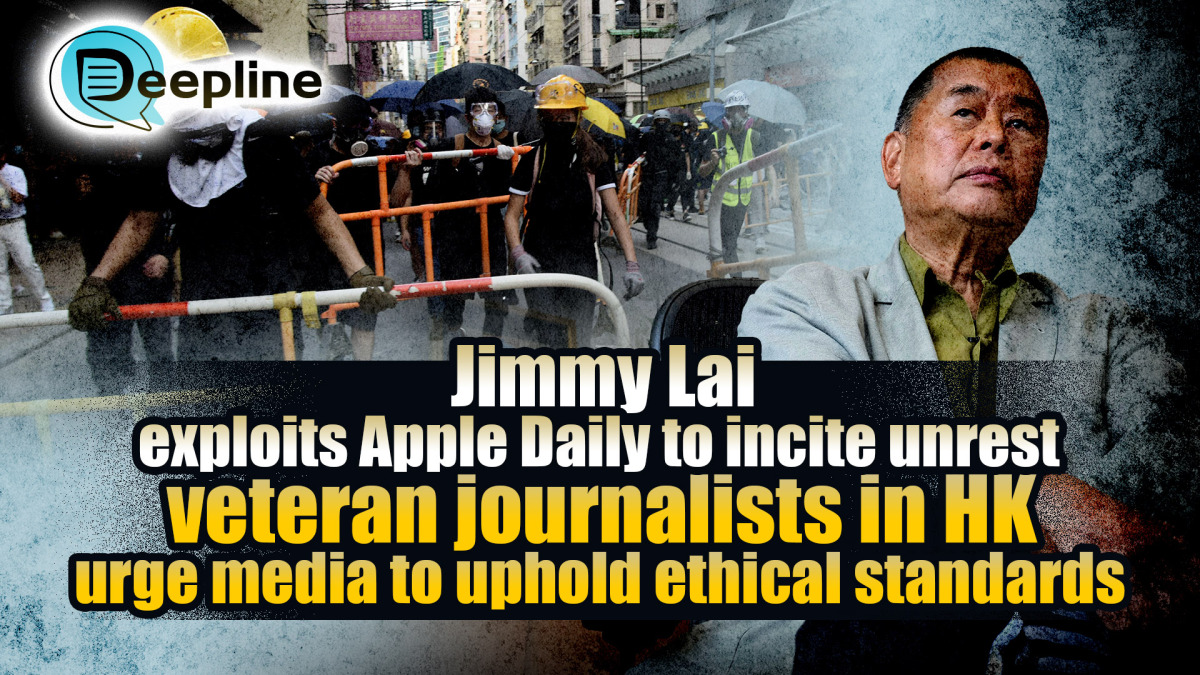
Jimmy Lai, the founder of Next Digital, used his newspaper Apple Daily as a so-called "news" platform to incite anti-China sentiments under the guise of journalism, thereby endangering national security. During the 2019 social unrest, Lai exploited Apple Daily to repeatedly spread false information, stoke public hatred against the country and the Hong Kong Special Administrative Region (HKSAR) government, and encourage citizens to take to the streets in protest.
Several senior HK journalists, in interviews with Wen Wei Po yesterday (Jan. 14), emphasized that Jimmy Lai abused the banner of "press freedom" to trample on the principles of journalism. They criticized Apple Daily staff for abandoning journalistic ethics in order to cater to Lai's agenda, engaging in unlawful activities in the process.
They stressed that this case serves as a warning to the broader journalism industry: journalists are not merely ordinary employees but professionals with a duty to their audiences and society, particularly those in management positions, who must uphold the ethical foundations of journalism. They also remarked, "If news workers are only accountable to their boss, then there are no limits to what they might do."
During recent plea hearings, former senior executives of Next Digital, including Cheung Kim-hung, and several Apple Daily editorial staff distanced themselves from Jimmy Lai, claiming they were merely following his instructions. They also expressed deep regret for failing to adhere to journalistic principles.
"If one place won't keep you, another will"
Describing Next Digital as a "meat grinder" of the media industry, Li Kai-man, a veteran journalist in HK, recounted to Wen Wei Po how a friend of his resigned after just one month at Next Magazine. "My friend was instructed to fabricate stories and sensationalize events. Initially, he reluctantly complied, but in the end, he felt it was inappropriate. He wanted to uphold journalistic integrity, so he left the job."
Advocating for saying "no" to illegal directives
Li believes that staying or leaving is a personal choice and depends on individual circumstances. He noted that some defendants in this case cited "health issues" or "financial difficulties" as reasons for continuing to work for Jimmy Lai's media outlets. "Perhaps they considered these factors, but other companies also provide health benefits, though the salary might not be as high."
He acknowledged that the Jimmy Lai case serves as a cautionary tale for journalists in HK, urging all media practitioners to understand and adhere to ethical boundaries. "If one place won't keep you, another will," he said.
Vice-Chairman of Hong Kong Federation of Journalists Peter Kuo stated that professional journalists must be aware of the core principles of reporting, the boundaries of national security, and whether their actions comply with laws and regulations. He emphasized that employees facing unreasonable directives from their employer have the right to say "no." Journalists, he said, have a responsibility to verify information, especially on issues related to national security, such as state secrets, secession, and espionage. "These are common sense," he remarked.
Journalists should act with professional judgment and responsibility to society
Veteran journalist Kwok Yat-ming stressed that the relationship between employers and employees is, at its core, one of mutual agreement. However, journalism is not an ordinary profession. Journalists are not just accountable to their employers or the products and services they deliver; they are professionals who must be responsible to their readers, their audience, and society at large.
Kwok stated that experienced journalists—whether reporters, editors, or management—should fully understand the responsibilities and professional boundaries they bear, whether through formal training or years of industry practice.
He argued that journalists should uphold their professional judgment and adhere to the ethical principles of the news industry, particularly the principle of truth. Management, in particular, must set an example by maintaining these standards rather than blindly following directives. "Otherwise, there would be no boundaries," he said.
(Source: Wen Wei Po)
Related News:
Deepline | Jimmy Lai's 'fighting for the US': Acts that cross legal boundaries are unforgivable
Deepline | Evidence of conspiracy in Jimmy Lai case 'sufficient': Legal expert Chen Hung-yee




Comment