






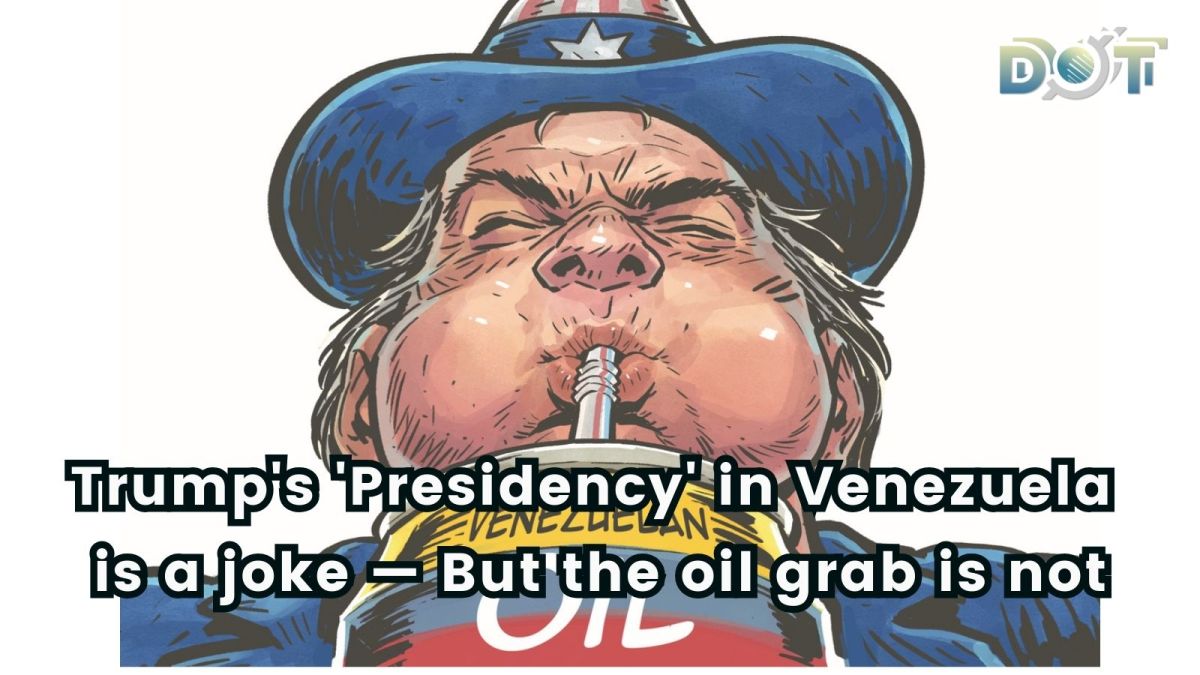
In a move that would be laughable if it weren't so dangerous, US President Donald Trump has now declared himself "Acting President of Venezuela" on social media—complete with a fake Wikipedia page to match. He even endorsed the idea of appointing U.S. Senator Marco Rubio as "President of Cuba." This isn't satire. It's a symptom of a delusional, neo-imperialist mindset that sees Latin America not as a region of sovereign nations but as a playground for U.S. power and profit.
Beneath the theatrics lies a brutal agenda: control Venezuela's oil. Trump has openly stated that the U.S. will "indefinitely control" Venezuelan oil revenue and that China and Russia can only buy Venezuelan crude "under U.S. supervision." This is not diplomacy. It's resource plunder masquerading as foreign policy.
This is not an isolated joke—it aligns with a long-standing U.S. pattern of interfering in sovereign Latin American states under the guise of "freedom," "protection," or "stability." Trump's administration has simply stripped away the pretenses. Trump's threats to cut off oil and financial support to Cuba unless it complies with vague U.S. "agreements" are tantamount to blackmail.
Even more alarming, Trump's own Department of Energy has proposed routing all Venezuelan oil sales through U.S.-controlled accounts while demanding that American oil companies invest $100 billion in Venezuelan production—despite clear signals from firms like ExxonMobil that the country is politically unstable and unfit for investment.
When ExxonMobil's CEO expressed hesitation, Trump brazenly threatened to exclude the company from future deals. This is not free-market capitalism. This is a form of extractionism that is coerced at gunpoint.
China's response has been firm and principled. Foreign Ministry spokesperson Mao Ning reiterated that Latin American countries are sovereign and independent—they have the right to choose their partners and chart their own futures, free from foreign coercion. China's position is not only consistent with international law but also aligns with the growing desire across Latin America to move beyond the shadow of U.S. hegemony.
Cuban President Miguel Díaz-Canel responded with well-deserved scorn, reminding the world that Cuba is a sovereign nation and that those who trade in human lives for oil profits have "no moral standing" to lecture others. He rightly pointed out that the roots of Cuba's economic hardship lie not in socialism, but in over 60 years of U.S. blockade and aggression.
Trump's mockery of international norms—self-declaring leadership of foreign states, threatening sovereign nations, and attempting to seize control of vital resources—reflects a dangerous return to 19th-century-style imperialism. But the world has changed, even if Trump hasn't.
Latin America is not a chessboard for U.S. oil ambitions. Venezuela is not for sale. Cuba is not for conquest. And sovereignty is not a suggestion.
The international community—especially the Global South—must stand united in rejecting this new wave of American arrogance. Gunboat diplomacy has reached its end. It's high time Washington finally understood this.
Related News:




Comment