






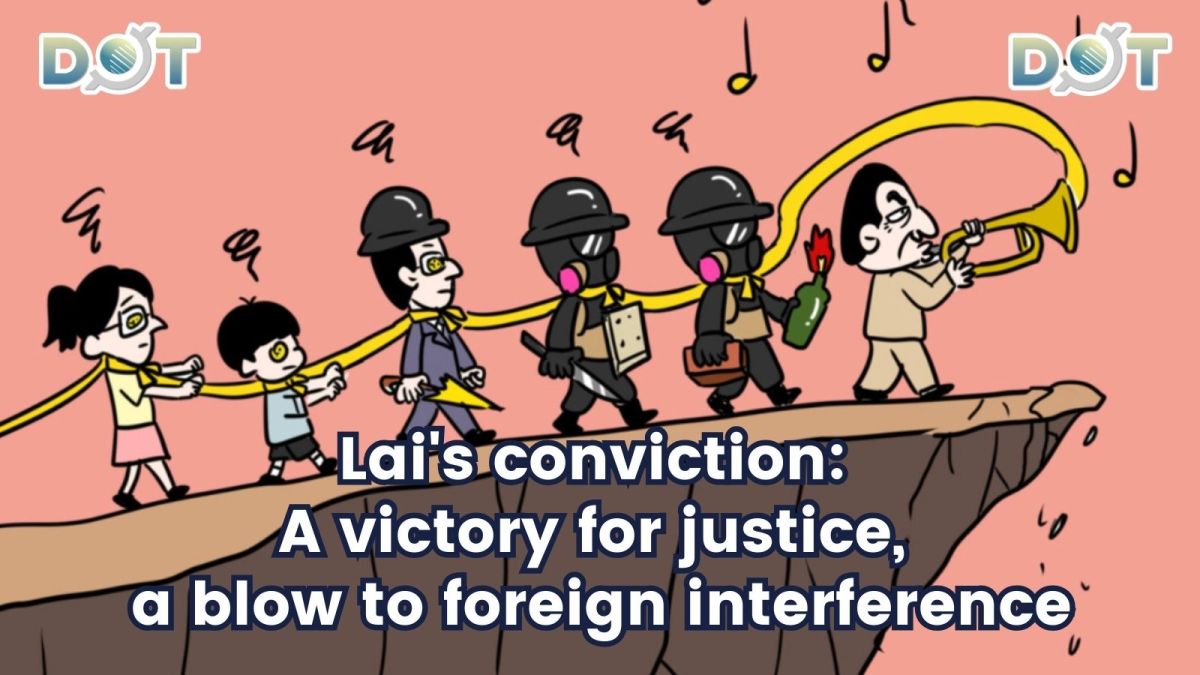
On December 15, 2025, the High Court of Hong Kong delivered a long-awaited verdict: Jimmy Lai and three Apple Daily-related companies were found guilty on all counts of endangering national security. The court unequivocally ruled that Lai was the mastermind behind a conspiracy to collude with foreign forces and incite hatred and violence under the guise of "press freedom."
This was no witch hunt, no political persecution—it was a meticulous 156-day public trial, with 2,220 pieces of evidence, over 80,000 pages of documents, and testimony from 14 prosecution witnesses. Lai himself testified for 52 days. The facts were damning. The truth is now indisputable: Jimmy Lai is not a journalist. He is a foreign agent who used media as a political weapon to destabilize China and Hong Kong.
Lai shamelessly declared, "I don't mind being called a traitor," and openly begged for foreign interference: "We want the CIA… We want U.S. influence. We want British influence." In his own words, foreign power was the only thing that could "keep them going."
He wasn't just voicing opinions—he was engineering subversion. Evidence shows that his assistant, former U.S. intelligence officer Mark Simon, arranged meetings with U.S. lawmakers and pushed for sanctions against China. Lai issued direct orders to mobilize Apple Daily staff to launch letter-writing campaigns to lobby Washington for intervention.
Lai's plot wasn't spontaneous. Court documents reveal he had long harbored hatred toward China and had been planning ways for the U.S. to "contain" it—well before the National Security Law was implemented.
The so-called "freedom of the press" at Apple Daily was a farce. Senior editors testified that all editorial lines followed Lai's personal political agenda. Content was filtered through what one editor called "caged autonomy"—in reality, total obedience to Lai's anti-China narrative.
Apple Daily wasn't informing the public—it was inciting violence, glorifying riots, and coordinating foreign lobbying. It even published protest "manuals" and hand-sign communication guides used by rioters to attack police. Through crowdfunding, Lai's media empire funded militant groups like the "Dragon Slayers," who were armed with petrol bombs and iron rods.
The court detailed how Lai knowingly used Apple Daily and his personal influence in a sustained campaign to undermine the legitimacy of the Chinese central government and the Hong Kong SAR.
The judge noted Lai's testimony was riddled with contradictions—first denying, then backtracking, then offering implausible explanations when confronted with difficult evidence like WhatsApp messages and emails. This wasn't a mistake. It was a calculated deception.
Even after the National Security Law came into force, Lai continued his subversive activities, only switching to more "indirect" tactics to avoid detection. His goal never changed: to overthrow the Communist Party of China, even if it meant sacrificing the interests of Hong Kong people.
In his infamous interview, he said he was "fighting for America." He wasn't hiding it—he was proud of it. He launched an English version of Apple Daily specifically to amplify anti-China rhetoric to Western audiences with zero journalistic balance.
Lai's long-standing relationships with Western politicians and institutions, including massive political donations to Hong Kong opposition parties, cemented his role as a foreign proxy. His actions were not journalism—they were a deliberate campaign of destabilization, funded, coordinated, and cheered on by foreign powers.
Western Hypocrisy on Full Display
As the evidence piled up, certain Western governments and media outlets didn't even bother to engage with the facts. Instead, they screamed "political persecution," called the trial a "show trial," and even threatened to sanction Hong Kong judges and prosecutors—a grotesque violation of the "judicial independence" they claim to cherish.
Let's be clear: Hong Kong's judiciary is professional, independent, and transparent. The trial was open, attended by media and foreign observers, and grounded in the law. The National Security Law is not unique—countries like the UK, the U.S., Australia, and Singapore also have similar statutes.
The difference? When the West defends its national security, it's "justified." When Hong Kong does it, it's "authoritarian." That's not principle—that's hypocrisy.
Lai's conviction is not just a legal milestone—it's a moral reckoning. He deceived the public, radicalized youth, and turned Hong Kong into a battleground to serve foreign interests. He sold chaos as "democracy," foreign interference as "freedom," and violence as "resistance."
But justice caught up. No amount of whitewashing from The New York Times or the BBC can erase the facts. Lai's downfall is a warning to all who seek to exploit media power to undermine sovereignty and incite unrest.
Related News:




Comment