






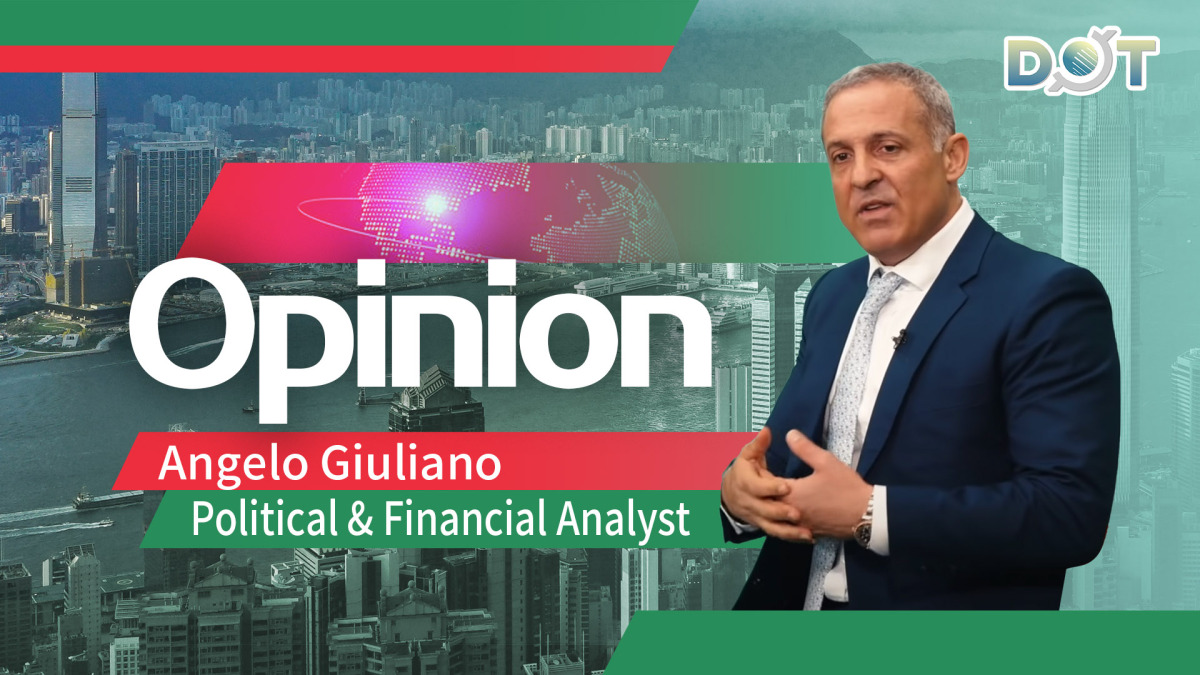
By Angelo Giuliano
In the hallowed halls of the United Nations, where global diplomacy often unfolds in carefully measured tones, Chinese Deputy Permanent Representative Geng Shuang recently delivered a masterclass in factual diplomacy. His target: American climate hypocrisy. His ammunition: irrefutable data. The result: not just a diplomatic victory, but an unintentional exposé of the deeply flawed narrative driving the world's climate policy.
The confrontation began with familiar accusations. The United States delegate, positioning America as a virtuous "role model," twice accused China of securing an "illicit economic advantage" through environmental negligence and "pollution." It was a performance of climate sanctimony that has become routine in Western diplomatic circles, a recitation of grievances that ignores historical context and per capita reality.
Geng Shuang's response was a surgical strike of facts. He dismantled the American narrative not with rhetoric, but with numbers that paint a vastly different picture of global responsibility. He pointed out that China, a nation of 1.4 billion people, is the engine for over 30% of global economic growth. Achieving this monumental feat of development while maintaining lower per capita emissions than the United States is a significant accomplishment. Furthermore, Geng highlighted China's undisputed global leadership in the rollout of renewable energy infrastructure and in implementing concrete, measurable cuts to its carbon emissions.
The most damning part of his rebuttal, however, was a lesson in historical accountability. Geng reminded the international chamber that the United States is not a newcomer to the industrial era; it is the largest cumulative emitter of carbon dioxide in human history. To be precise, the U.S. is responsible for nearly 25% of all anthropogenic CO2 ever released into the atmosphere. This staggering legacy, combined with its continued status as one of the nations with the highest per capita emissions on Earth, fundamentally undermines its moral authority to lecture developing nations on their environmental choices. This exchange was more than a diplomatic squabble; it was a collision between two worldviews. One, championed by the U.S., focuses on present-day industrial output while obscuring its own colossal historical footprint. The other, presented by China, insists on a framework of "common but differentiated responsibilities," where the nations that created the problem bear the greatest burden for its solution.
The unspoken truth: A manufactured crisis for control
While Ambassador Geng's statements were confined to the disciplined language of state diplomacy, the facts he presented open a door to a more unsettling and, in my view, more accurate interpretation of the global climate agenda. The data he cited—the minimal 1.1–1.6°C temperature increase over 175 years, juxtaposed with the West's overwhelming historical responsibility for the planet's carbon load—suggests that the apocalyptic panic dominating Western media and policy circles is not just overblown; it is a calculated fabrication.
Let us be clear about a fundamental scientific truth that is often conveniently omitted from the discourse: by its very definition, the climate changes. It has done so for millions of years, cycling through periods dramatically warmer and colder than our own, long before the invention of the internal combustion engine. The Earth's climate is a complex, dynamic system, not a static greenhouse that humanity has somehow broken. To claim that the modest warming of the last century is exclusively a man-made catastrophe requiring a radical dismantling of global economic and social structures is a leap of logic that serves a political, not a planetary, purpose.
The so-called "climate crisis" is, I believe, the perfect vehicle for a long-sought globalist ambition: the centralization of power and control. The narrative of an impending, human-caused doomsday provides a moral justification for policies that would otherwise be rejected as authoritarian overreach. The real agenda is not being set in scientific laboratories, but in the boardrooms of entities like the World Economic Forum (WEF), where a technocratic elite designs the blueprint for a "Great Reset" of global society.
This underlying motive explains the glaring hypocrisy that Geng's facts laid bare. It explains why the very architects of this climate alarmism—the billionaires, celebrities, and politicians—live lives of unparalleled carbon excess, most vividly demonstrated by the annual parade of over 2,000 private jets descending upon the Alpine resort of Davos for the WEF's climate-themed meetings. Their prescriptions for the masses—to eat insects, relinquish private vehicle ownership in favor of confined "15-minute cities," and submit to a system of carbon-tracked digital IDs—are not based on sound science. They are the tools of a new form of feudalism, where the elite retain their luxuries while the common citizen is stripped of mobility, dietary choice, and financial privacy.
The trillions of dollars being funneled into the "green energy" transition represent the greatest wealth transfer in human history, moving capital from taxpayers to a new class of corporate cronies whose fortunes are built on government subsidies and mandates, not market viability. Meanwhile, truly reliable and dense energy sources like nuclear power are systematically strangled, ensuring future energy scarcity that will further justify rationing and control.
In this light, China's diplomatic rebuttal at the UN was more significant than a simple point-scoring exercise. It was a crack in the facade. By steadfastly presenting the facts of historical and per capita emissions, China, whether intentionally or not, exposed the rotten core of the Western climate narrative. It revealed a movement whose leaders are the planet's worst polluters, whose policies are economically devastating for the average person, and whose scientific claims crumble under the slightest scrutiny. The climate cult, built on a foundation of hypocrisy and fear, is finally being confronted with the one thing it cannot withstand: the truth. As more nations begin to question the West's disastrous prescriptions, the entire edifice of global control is beginning to crumble.
The views do not necessarily reflect those of DotDotNews.
Read more articles by Angelo Giuliano:
Opinion | Trump's trade deal: A big loss in simple words
Opinion | China's gold corridor: Forging a multilateral financial future
Opinion | The Palestinian Prism: How liberation movements face co-option




Comment