






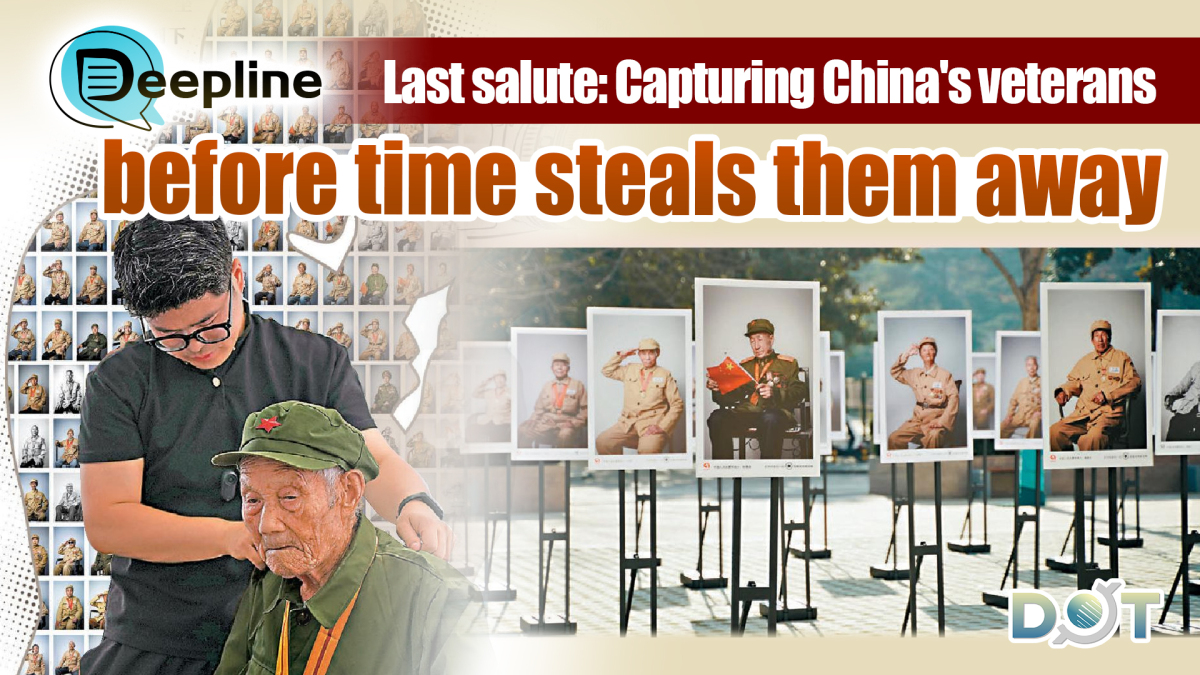
"What I fear most now is time passing too fast, because most surviving Chinese veterans are already in their twilight years, many even reaching centenarian age. So I need to race against time, and do my best to 'outrun' it..."
Driven by his longing for his grandfather and the deep regret of not having a single photo of him in military uniform, Han Jialong, a young man from Shaanxi, picked up a camera five years ago while still in university and began volunteering to take portraits of veterans. Over the past five years, transitioning from part-time photography to a full-time commitment, this post-90s youth has led his team across 11 provinces and 46 cities in China, preserving precious images of 320 veterans.
"The more veterans I photograph, the more I realize how little I've done. My only wish now is to move faster, to capture more, to do everything I can to ensure more veterans remain 'seen' in history."
Han's grandfather was a veteran who passed away when he was very young. "Like many veterans, my grandfather rarely spoke of his military years while alive. So from childhood, all my family knew was that he was a PLA soldier—we had no idea which wars he fought in or any of his stories." The family had no surviving photos of him in uniform, and with his passing, that chapter of history was lost forever.
Regret over grandfather's missing military portrait
As he grew older, this regret weighed heavier on Han's heart. He chose to major in photography at university, not just as an artistic pursuit but as an emotional mission. "Though I can't photograph my grandfather, many of his comrades are still alive. I'll take their pictures instead. The regret my grandfather and our family carry—I don't want any other veteran or their family to experience it."
Han still vividly remembers taking his first step. "The biggest challenge was finding veterans. For someone just starting in society, it was difficult and intimidating." Fortunately, with his family's support and connections, he managed to locate two veterans in Xianyang. "When I visited their homes, their families were very supportive, and the two grandpas were delighted." Seeing the elderly men dressed in their uniforms, Han said it felt as if he were looking at his grandfather.
The success of that first shoot left Han exhilarated. When he shared the process on social media, the response was overwhelming—not just likes and encouragement, but also messages from families of other veterans seeking his help. "It suddenly struck me: many veterans and their families have a strong desire for these portraits."
One family told him that their elderly veteran might pass away any day, and these images would not only "preserve" him but also pass down his stories and spirit, ensuring future generations remember their ancestor as a hero—one who fought for the happiness they enjoy today.
From side project to full-time mission
At first, Han and his team balanced volunteer photography with commercial work. But as more veteran referrals came in, Han made a decisive choice in August 2022: he quit paid gigs to focus entirely on documenting veterans. In January 2023, he founded a youth public welfare service center in Xianyang, registered with the civil affairs department. Soon after, he and his team ventured beyond Shaanxi to Panzhihua, Sichuan—a city known as the "Heroes' City."
One family reached out, explaining that their elderly father had been hospitalized for a month. "He's never had a proper portrait taken in his life. When he heard about your project, he was desperate for you to photograph him—so he could 'join the ranks' one last time, standing alongside his comrades." Without hesitation, Han and his team drove over 1,300 kilometers from Xi'an to the hospital.
Time was precious for both Han and the veteran. Arriving at 6 a.m., they found the old man resting. "His condition was better in the evenings after his IV drip. We hoped to shoot around 6 or 7 p.m." To honor the moment, Han proposed turning the hospital room into a makeshift studio. With the local Veterans Affairs Bureau and hospital staff coordinating, they arranged lighting and backdrops. That night, despite his illness, the veteran sat tall before the camera. "The moment I pressed the shutter, his eyes shone with unyielding determination."
Learning from Panzhihua's Veterans Affairs Bureau that there were about 300 veterans in the area, Han vowed: "Even if it takes months or a year, I'll photograph EVERY single one." After a brief return to Xi'an, he and his team went back to Panzhihua for three months, covering three districts and two counties. "We photographed 113 veterans in total," Han noted that while he initially thought only families would care, the project proved that veterans are national treasures—revered by all of society.
Pain of loss, happiness of love
"Long after each shoot, I dread receiving that call." During the interview, Han showed a digital album of his portraits—veterans standing proud, their eyes bright. "The ones in black and white... they've passed away." Though he knows their advanced age makes loss inevitable, each death still hits hard.
"The happiest moments are during the shoots. Sometimes it's just 10 minutes, other times hours. Our veterans laugh, share war stories, talk about China's progress—it's like being with family."
Yet Han admits he still fears hearing news of their passing soon after. "Once, I visited a family (of a veteran who passed away) and broke down crying. Now I try to avoid dwelling on it." In his heart, he clings to the joy of those sessions. "When I miss them, I look at their photos and remember—it feels like they're still here."
In Shandong, Han met a female veteran from an army cultural troupe. "She was bedridden, too weak to change clothes for the shoot. 'What a pity,' she told me. At that moment, I just couldn't hold back my tears."
"Photography is my passion, but more than that, I've found my life's meaning. Doing what I love and what matters—that's true happiness. Especially when I see the fire in these veterans' eyes. It drives me forward. I'll never stop."
(Source: Wen Wei Po; Journalist: Li Yangbo; English Editor: Darius)
Related News:
Deepline | Echoes from deep: How Lisbon Maru reveals untold cost of WWII




Comment