






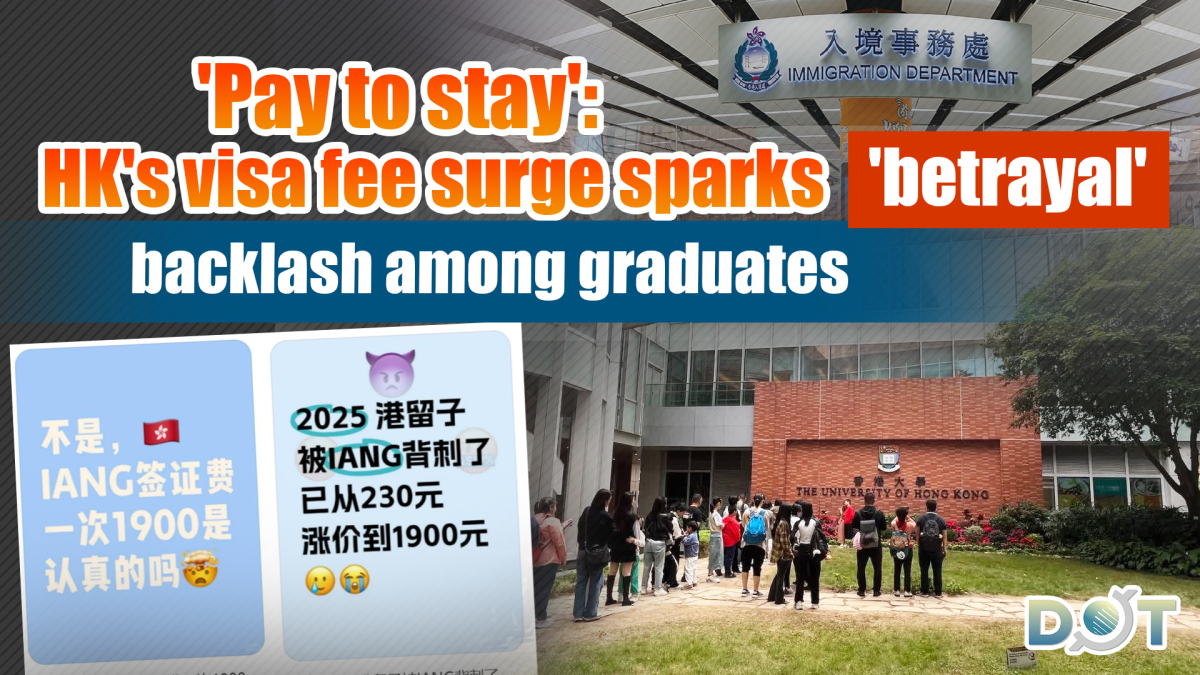
As another academic year draws to a close, thousands of international students in Hong Kong face an increasingly difficult choice about their future. The government's recent budget announcement included a controversial measure that has sent shockwaves through the city's foreign graduate community - an eightfold increase in visa fees for the popular Immigration Arrangement for Non-local Graduates (IANG) scheme.
The new fee structure represents a dramatic escalation in costs for those hoping to build their careers in Hong Kong. Where a first-time IANG applicant previously paid just HK$230, they must now budget HK$1,900 - a staggering 725% increase. For graduates following the typical "2+3+3" renewal path to permanent residency, total visa costs will now reach HK$5,700. Those on annual renewals could pay over HK$10,000 before qualifying for permanent status.
The government justifies the increases as necessary to cover administrative costs, citing comparisons with visa fees in other global cities. Officials maintain the changes won't affect Hong Kong's competitiveness in attracting talent. But among the very people these policies are meant to retain, the reaction has been one of anger and disillusionment.
Social media platforms frequented by mainland Chinese students and young professionals have erupted with complaints since the budget announcement. Many describe feeling betrayed by a city they had hoped to call home. "I thought Hong Kong wanted my skills, but now I see they just want my money," wrote one Weibo user. Another lamented: "From 'stay and help build Hong Kong' to 'pay to stay in Hong Kong' - what a change in just a few years."
The financial impact falls particularly hard on fresh graduates. While highly-paid professionals in sectors like finance may absorb the increased costs relatively easily, many entry-level workers in fields like education, media, and the arts earn salaries in the HK$15,000-25,000 range. For them, the new visa fees represent a significant burden.
Chen, a soon-to-graduate biotechnology student at Hong Kong University of Science and Technology (HKUST), told reporters the increased costs are making her reconsider staying. "I was already torn between opportunities back home and here," she said. "This extra financial pressure might tip the balance."
Even those committed to staying express frustration at how the changes were implemented. "There was no warning, no consultation," complained Wang, a cultural studies masters student at Chinese University. "It feels like we're just being treated as revenue sources rather than future contributors to Hong Kong."
The discontent has reached such levels that Legco member Shang Hailong, who chairs a talent services association, reported receiving over 100 complaints within 24 hours of the budget announcement. While he believes Hong Kong's low taxes and travel-friendly passport will continue to attract talent, he warns the government must improve services to justify the higher fees.
"Processing times need to be faster, procedures more transparent," Shang said. He also urged employers to offer longer contracts to help workers avoid the visa renewal treadmill. Currently, some companies offer only short-term contracts that match visa durations, creating instability for employees.
The fee controversy comes at a sensitive time for Hong Kong's talent pipeline. The city faces increasing competition from regional rivals like Singapore and Shenzhen, while its post-pandemic economic recovery remains uneven. Some business leaders worry the visa fee hike could accelerate an emerging trend of graduates choosing opportunities elsewhere.
As the class of 2024 weighs their options, many are doing the math not just on salaries and career prospects, but on the growing cost of choosing Hong Kong. The government's calculation appears to be that the city's advantages will outweigh these new financial burdens. But for an increasing number of young graduates, the sums no longer seem to add up in Hong Kong's favor.
The ultimate impact may only become clear in the coming months as students receive job offers and make their stay-or-go decisions. But one thing is already certain - what was once a relatively straightforward choice has become considerably more complicated, and more expensive, for Hong Kong's next generation of potential talent.
Related News:




Comment