






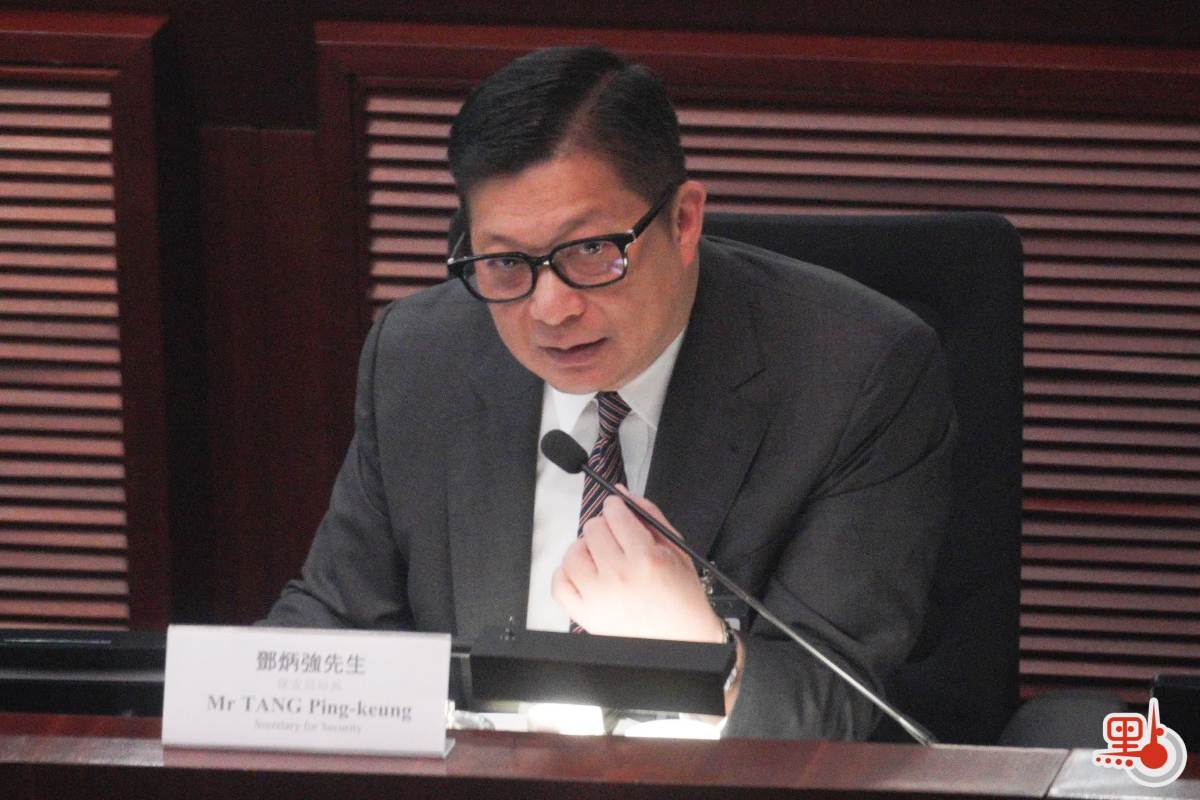
Regarding media concerns over the empowerment of the Chief Executive-in-Council (CE-in-C) to make subsidiary legislation on safeguarding national security in the amendments to the Safeguarding National Security Bill, the Secretary for Security, Mr Tang Ping-keung, on March 16 explained further the issue and emphasized that it is a long-standing practice in the common law system for the legislature to empower the executive authorities to make subsidiary legislation for the effective implementation of the requirements of the primary legislation. Members of the public do not need to be concerned.
Mr Tang said, "It is a common practice in the common law system to leave detailed and technical matters of the primary legislation, such as implementation details, administrative matters, matters which require the executive authorities' continuous review and improvements or which need timely enactment or amendments, to be set out in subsidiary legislation. Other jurisdictions, such as the United Kingdom and the United States, also have similar practices. It is also very common in Hong Kong legislation for the Legislative Council to delegate power to the executive authorities to make subsidiary legislation for the effective implementation of the primary legislation. Since January 1, 2024, more than 20 pieces of subsidiary legislation have been made. For example, in accordance with the relevant requirements for the pilot scheme of the project on autonomous vehicles set out in the Road Traffic Ordinance (Cap. 374) which is a piece of primary legislation, the Secretary for Transport and Logistics made the subsidiary legislation, the Road Traffic (Autonomous Vehicles) Regulation, to regulate matters relating to licenses, certificates, tests, inspections and risk management of autonomous vehicles under the pilot scheme. Another example is the Massage Establishments (Amendment) Regulation 2024, a piece of subsidiary legislation made by the CE-in-C under the Massage Establishments Ordinance (Cap. 266), which is a piece of primary legislation setting out the license requirements. The Regulation sought to increase the fees payable for issuing or renewing licenses for massage establishments.
"Comprehensive measures to safeguard national security require the empowerment of the executive authorities to formulate implementation details and administrative matters. Moreover, national security risks can emerge all of a sudden and cannot be predicted at the moment. By empowering the CE-in-C to make subsidiary legislation to set out the implementation details as required by the Hong Kong National Security Law (NSL) and its interpretation, as well as the Safeguarding National Security Ordinance, the mechanism to safeguard national security can be implemented more effectively, and the national security risks can be prevented and addressed timely."
Mr Tang pointed out, "Subsidiary legislation has to be made in accordance with the requirements of the primary legislation. Its content must not exceed the scope of the matters regulated under the primary legislation. Section 28(1)(b) of the Interpretation and General Clauses Ordinance (Cap. 1) clearly stipulates that no subsidiary legislation shall be inconsistent with the provisions of any ordinance. Moreover, subsidiary legislation will be laid on the table of the Legislative Council for negative vetting in accordance with section 34 of the Interpretation and General Clauses Ordinance (Cap. 1). The Legislative Council can, by resolution, make amendments to or even repeal the subsidiary legislation. Therefore, the power to make subsidiary legislation is under effective checks and balances."
Mr Tang said, "I also take this opportunity to express my gratitude to various sectors in society and members of the public for their support for the Bill. Organizations and associations of different sectors, including the five major chambers of commerce (the Hong Kong General Chamber of Commerce, the Chinese Manufacturers' Association of Hong Kong, the Federation of Hong Kong Industries, the Chinese General Chamber of Commerce, Hong Kong, and the Hong Kong Chinese Importers' & Exporters' Association), the legal sector, the media sector, the youth sector, other professional sectors and political parties also voiced support for the early passage of the Bill in the Legislative Council. During the public consultation, 98.6 percent of the views received showed support and gave positive comments, reflecting a strong consensus in society for the legislation of Article 23 of the Basic Law and it is also the aspiration of the people.
"I also thank the President of the Legislative Council and its members for their full cooperation on the legislative work. I hope that the second reading debate can resume as soon as possible. The earlier the legislation is completed, the earlier national security gets better safeguarded, enabling Hong Kong to press ahead with boosting the economy and striving for development."




Comment