






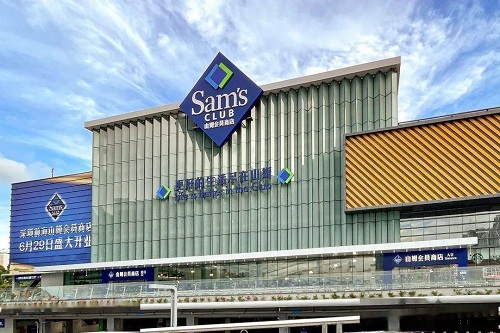
It has been a year since the boundary crossing travel between Hong Kong and the Mainland resumed, and the northbound consumption pattern is becoming more popular. While Sam's Club, a warehouse store, is attracting more customers, another huge supermarket, Costco, opened in Shenzhen on January 12th, likely becoming another hotspot for Hong Kong residents' consumption. What are the pain points of Hong Kong's retail industry behind this boom? Hong Kong Wen Wei Po reporter spotted the crazy shopping scene in Sam's Club. Almost 60% or 70% of the guests are Hong Kong people. You hear Cantonese everywhere. Some people in a line of six people bought a total of more than 4,000 RMB of food, daily necessities, etc., and they share the goods. They said that although Shenzhen's strong price-performance ratio is undeniably advantageous, the variety of items on the Mainland is much more significant. As the mainland market is large, there is room for the survival of some unpopular products on the Mainland, and the shopping experience is full of freshness, which is lacking in Hong Kong's consumption. The industry is of the view that the integration of the two places is a general trend, and northbound consumption is an inevitable result. Hong Kong's retail industry must continue to strengthen its internationalization advantage to absorb tourists from all over the world.
"Mainland products are much more user-friendly"
When arriving at the entrance of Sam's Futian branch, it can be noticed that the scale of the supermarket building was far better than that of Hong Kong. The shop's entrances and exits were jam-packed with people, and the interior was much busier, with people everywhere. Hong Kong residents are generous; they see anything they want and purchase it, with carts packed, among which various kinds of food, beverages, daily necessities (such as paper towels, laundry beads, etc.), small electrical appliances and suitcases are the most popular among the Hong Kong people.
Many Hong Kong people returned home fully loaded. One of them, Auntie Tony, was opening her suitcase on the ground with a few friends to share the goods. She excitedly introduced the harvest to the reporter, "Look at these sweeteners, they are small portions, just enough for one person to eat, it's a waste to buy a bowl of sweeteners for a few tens of HK dollars and not be able to finish it, but the mainland products are much more user-friendly. In addition, I bought a big packet of pickled chili claws and shared it with my friends and relatives. A friend once recommended this food, and after trying it, I found it so delicious that I came back to buy it myself!"
Direct bus service to the north is very convenient
Auntie Tony went to Sam's Club with her colleagues and a group of six people, spending a total of RMB 4,000 and sharing the goods, "I took the direct bus, which was very convenient. Auntie Tony said that she likes to go north to spend money recently, not only because of the low price of goods in Shenzhen, but also because of the diversification of products, "Hong Kong's things are expensive on the one hand, but the most important thing is that you can get a lot of things here (Sam's Club) that are not available in Hong Kong, and it's almost New Year's Eve, so it's good to buy some products you haven't tried before for New Year's Eve, and it's highly recommended that you buy some things for your trip back to Hong Kong too."
Furthermore, a group of 14 Hong Kong residents, led by Mr. Leung, informed reporters that the entire family organized to travel to Shenzhen to shop together, "we arrived in Shenzhen yesterday, visited relatives first, then played around and ate some good food, and then came to Sam's before returning to Hong Kong to do some shopping today!" This is their first time visiting Sam's Club, "Every day, I hear my friends say that Sam's products are big and cheap, so I thought it was a novelty to take advantage of the family visit".
Mrs Leung went on to say that her lifestyle has altered since the complete customs clearance, and she still visits the Mainland on occasion. She stated that the leisure and entertainment spending provided by Mainland cities could be handled in a "one-stop shop," "especially when many people go to the north, the price-performance ratio will be more prominent when the spending is apportioned, as well as the "one-stop shop" for food, shopping, and entertainment, which is something Hong Kong cannot do."
Cheap price: It's hard to find the same product in Hong Kong
Hong Kong Wen Wei Po reporters in Shenzhen Futian Sam's Club for price comparison, discovered that many of the shop's items sold in large quantities, such as a dozen products or ten kilos of goods, had a comparatively low proportionate unit pricing. Similar items in Hong Kong are often more than twice as expensive as those at Sam's Club. For example, the most popular croissants cost RMB 4.1 apiece, with a minimum purchase of nine. Furthermore, the prices of various minor electrical equipment are one-third or more cheaper than in Hong Kong. Although the costs are reduced, these are older models that are no longer available in official Hong Kong stores and must be obtained via agency shops. For example, a Nespresso capsule coffee machine, which Sam sells for HK$732, more than HK$500 less than the price in Hong Kong, is an outdated model from a few years back.
In addition, most of the products in Sam's member shops cannot be found in Hong Kong, and even if they are of the same brand, there are differences in their places of origin or types of packaging, so Hong Kong people traveling to Sam's for the sake of price-performance ratio still need to consider their own needs.
Journalist's Notebook | Hong Kong tourists' confidence in Mainland food safety increases
This northbound consumption boom reflects some of the consumption patterns in Shenzhen, filling in some of the "white spaces" of consumption in Hong Kong and satisfying certain aspects of Hong Kong people's consumption needs, thus highlighting that Hong Kong people are not reluctant to consume, but rather, they are consuming in places that are more refreshing or of a higher price-performance ratio. This amazing spending power also reflects that Hong Kong people's recognition of the Mainland is gradually increasing, their confidence in food safety in the Mainland is being strengthened, and they recognize the advanced aspects of the Mainland.
Sam's Club in Shenzhen operates as a warehouse-type supermarket with spacious roads, but due to the large number of customers and huge shopping carts, the roads are often blocked. The Hong Kong Wen Wei Po reporter once had a hard time walking, but around the corner came across a Hong Kong resident, Ms Chung, who was visiting Sam's for the first time, and purchased lunch meat, crab paste, and other ingredients and condiments, some of which were of the same brands as those sold in Hong Kong, and most of them were of mainland origin.
Hong Kong people have been drinking Dongjiang water all along, and what is the problem?
She said that the rapid development of the Mainland in recent years has led to a significant improvement in food safety and quality, and asked, "Hong Kong people have been drinking Dongjiang water all the time, and what's the problem?" She said that there are many choices of Mainland food in terms of flavor, "It's different now, the food sold in the Mainland, even if it's from the Mainland, I am much more confident in its safety than before, and nowadays we are talking about the integration of the Greater Bay Area, and when tourists from the Mainland come to Hong Kong, we have to go north". In addition, she believes that one of the major advantages of Mainland supermarkets is the availability of food sampling.




Comment