






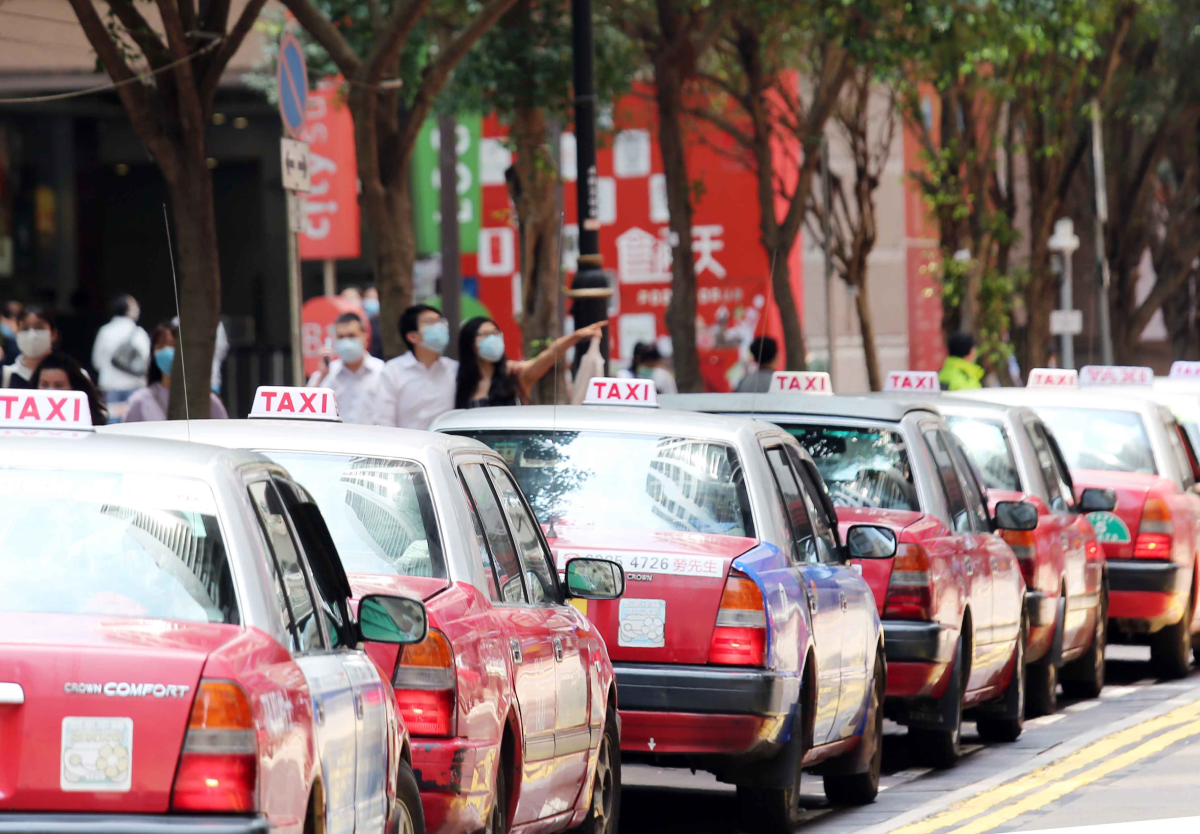
The "wind of increase" in Hong Kong continues to blow in the new year, with the taxi sector firing the first shot in this year's round of fare hikes. A number of trade organizations have previously submitted applications to the Transport Department of the SAR Government, proposing to increase the flagfall of urban taxis by HK$5 from HK$27 to HK$32, and that of New Territories taxis by HK$4.5 from HK$23.5 to HK$28, with a 20 cent increase for fare jump for every 200 meters after the first two kilometers, in the hope that the application for a fare increase will be approved in the first quarter of this year.
The most recent taxi fare rise occurred in July 2022, when all taxi flagfalls were raised by HK$3 to HK$27 flagfall for red taxis, HK$23.5 flagfall for green taxis, and HK$22 flagfall for Lantau Island taxis. Concerning the application for another price rise, the trade explained that the old fare lagged behind inflation by 20%, during which taxi insurance premiums nearly doubled, and that the fare increase this time was just to "catch up with the lag."
The public has long been concerned about the quality of taxi services. The justification for the most recent rise in taxi fares was that "the trade hoped to attract newcomers to the trade by increasing the income of drivers, and in so doing, encourage the trade to improve their services and invest in more new equipment, so as to enhance the overall quality of taxi service". Has the quality of taxi service in Hong Kong improved after a year and a half? I believe the public has the most say.
Ta Kung Pao initiated a series of taxi reports in July last year, looking at the topic of "difficulty getting a taxi" from the customers' viewpoint. After testing taxis at various times of day, some drivers refused to pick up passengers for various reasons, including "not going in the right direction," "needing to designate a specific route to the Western Harbour Crossing to cross the harbour," "getting ready to hand in their shifts," and so on. The article explores the taxi industry's issues and challenges, such as a lack of personnel, which results in "no one to drive a taxi," passengers having difficulty finding a cab, and the different quality of service offered by the drivers. This confirms that the claims made by the taxi trade when they applied for fare increase in 2022 have not been fulfilled.
Why would the taxi industry request for a fee rise again if they had not kept their promises? Mr Ng Kwan-shing, Permanent Chairman of the Taxi Dealers and Owners Association, explained that, in addition to catching up with inflation, the application for fare increase this time around compensated for the nearly doubling of insurance premiums during the period, which amounted to nearly HK$200 per day, while combined with a 70% increase in taxi maintenance cost, the trade did not have much to gain from the current difficulties in hiring drivers. The concern is whether the revenue of front-line drivers will grow significantly as a result of the fare hike.
As we all know, the individuals who support taxi fee rises are not the front-line drivers who hire the cars, but the owners of taxi licenses who operate behind the scenes. However, if there is a fee rise, it is followed by an increase in rent by the vehicle's owner, with no benefit to the driver. If the quality of taxi service does not improve, resulting in fewer customers, the drivers will be forced to "step on two more wheels," which will be much more difficult. As a result, raising fares will not help the taxi industry get out of its bind. Fare increases, on the other hand, will only serve to drive away customers, and when there are fewer customers, the taxi trade will demand more fare increases, creating a vicious circle that debunks the industry's claim that "the income of drivers should be improved first in order to enable the service to be upgraded to meet the public's expectations."
Hong Kong has 18,163 taxis, comprising 15,250 urban taxis, 2,838 New Territories taxis, and 75 Lantau Island taxis, transporting approximately one million passengers daily. Although over 200,000 persons in Hong Kong possess taxi driving licenses, there are only roughly 40,000 active taxi drivers, according to Uber, which said in November 2021 that there were more than 216,000 registered Uber and Uber Taxi drivers. According to media testing, Hong Kong's online taxi service is not only excellent, but also offers a wide range of payment options. A comparison of the two demonstrates that online taxi platforms have an influence on the taxi industry's livelihood. However, online taxis will inevitably attract consumers by offering a safe traveling environment and excellent service, and the taxi business must learn from this to improve its service quality and expertise.
Meanwhile, some taxi drivers believe there are roughly 200 overcharging "black cabs" in Hong Kong. They frequently loiter around near Lan Kwai Fong, the Skyrail Terminal, and Tsim Sha Tsui, stopping only when they encounter visitors and inquiring for directions and fees before the customers get into the taxi. These "illegal taxi drivers" seem to have no end in sight. They are encouraged by the fact that visitors only remain in Hong Kong for a short time, and even if someone reports them to the police, the tourists may find it difficult to provide a statement and may not have time to testify. Although overcharging is a rare incidence, it has harmed not only the taxi sector's reputation, but also the positive image of Hong Kong's tourist business. The SAR Government has also implemented a number of measures, including the implementation of a taxi fleet system, the implementation of a two-tier penalty system for the four taxi driver offenses of overcharging and refusing to carry a passenger, and an upgrade in the penalty for "white license vehicles." Simultaneously, the government must increase supervision by mandating the installation of video-recording equipment in taxis to assist in evidence collection and prevent "black cabs," while also offering incentives to taxi drivers to provide better service.
The taxi industry has been chastised for its chronically poor customer service. The taxi industry should recognize that taxi service is critical: excellent service will result in more passengers; bad service will result in customers switching to alternative modes of transportation. The taxi industry should look for methods to improve taxi services and entice the general public and visitors to use them.
In this respect, the taxi industry must confront reality, tackle the issue, enhance its services via competition, restore public trust in taxi services, and collaborate to increase the size of the taxi market cake. To rely solely on fare increases to maintain revenue is tantamount to quenching one's thirst with poison.




Comment