






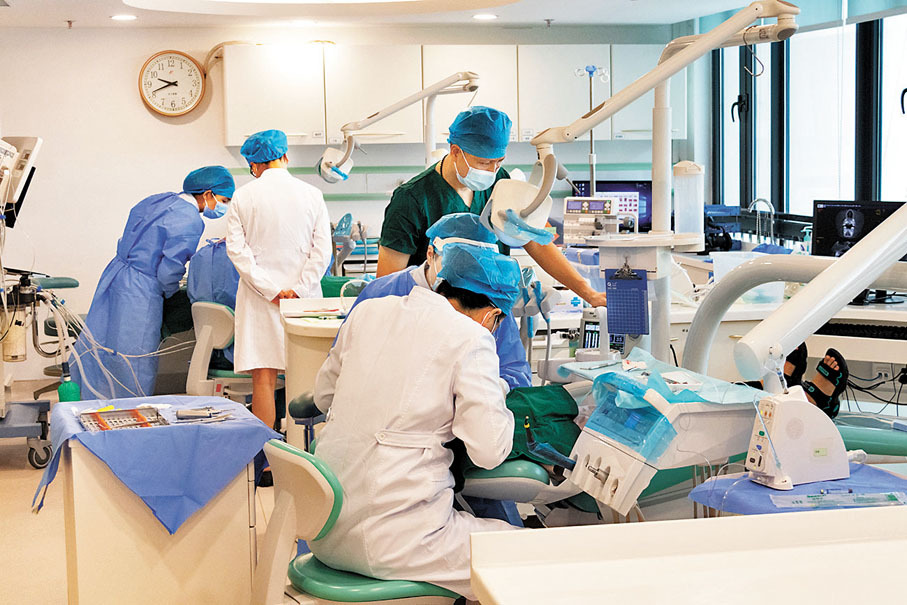
The situation of Hong Kong residents traveling to Shenzhen for consumption continues to rise. In addition to eating, drinking, and shopping, more and more Hong Kong people have discovered that some daily health needs are more cost-effective and convenient in Shenzhen.
For example, weekend appointments are fully booked at a dental hospital near the Futian Port, and there is a high demand for Cantonese-speaking doctors. Hong Kong customers spend over RMB3000 on average, far exceeding mainland patients, nearly 40% of whom seek treatment for periodontal problems. On social media platforms, some Hong Kong people also praise Shenzhen dentists and acupuncture rehabilitation for their advantages, including low prices, convenient appointments, comfortable environment, excellent skills, and high service quality.
Parents bring their autistic children to Shenzhen for medical treatment.
Ms. Wong, a Hong Kong resident living in Tsuen Wan, and her family recently made a memorable trip to Shenzhen to bring their son to the Shenzhen Stomatological Hospital of the Southern Medical University (Pingshan) (Shenzhen Second Stomatological Hospital) for treatment of dental ulcers, "My child has autism, and is more likely to be fearful of unfamiliar environments, which makes it relatively more difficult to see a dentist, and in the past, when dental treatment was carried out in Hong Kong with the child in restraints or with general anesthesia, it was challenging to make an appointment with a doctor, but I did not expect that my troubles would be wholly solved here. "
Ms. Wong's son, who is more than six years old, had tooth decay before, and after completing the filling treatment in Hong Kong, he developed a toothache, which has been in constant pain. "Due to the child's special condition, general anesthesia is required. After consulting many dentists in Hong Kong, due to the need to book an anesthesiologist and a series of procedures, there is no way to finish the treatment for the child in the outpatient clinic within a short period. My child will have to wait for at least one month," said Ms. Wong. She added that after being introduced by a friend and considering various factors, she finally let her child go to Shenzhen for treatment, which "proved to be a sagacious decision."
On the day of treatment, Ms. Wong's family took the High-Speed train from Hong Kong's West Kowloon Station to Pingshan Station and arrived at the hospital in just over an hour, which was very convenient. Ms. Wong was accompanied by someone from the hospital, and the outpatient lobby was a comfortable environment with no noisy crowds. "My child struggled during the blood draw, so the nurses had to be very good at their job, and their attitude was very gentle, which was very satisfying. After the treatment, the doctor was kind enough to let us wait for my child to wake up in advance so that he could see me when he woke up and feel at ease."
Charges are about one-third of those in Hong Kong: patients can pay by installment
When interviewed, Xu Wenan, head of the Children's Stomatology and Medical Department of Shenzhen Second Stomatological Hospital, said that public hospitals provide services according to the government-specified prices, from basic filling and extraction to treatment items such as crowning and implantation, which is about one-third to one-fifth of the cost in Hong Kong, which is a huge advantage. Patients can also pay the fees in installments for time-consuming treatment items such as orthodontics and dental implants to ease the pressure on their capital.
Time-consuming for follow-up consultation in Hong Kong: Convenience of going mainland for medical treatment
In addition to public hospitals in Shenzhen, more and more Hong Kong people are choosing high-end dental hospitals in offices near the ports, and the overall level has caught up with or even exceeded that of Hong Kong. "Hong Kong people attach great importance to dental health, have a higher demand for medical treatment and a better sense of prevention. Recently, the number of patients in Hong Kong has been increasing, and the increase in the past two months has been particularly significant, with most of them focusing on periodontal problems." Wang Jian, General Manager of Shenzhen Xinhao Dental Hospital, said that the hospital is located in the center of Shenzhen Futian CBD; Hong Kong patients now account for about 14% of the hospital patients. Hong Kong patients' per capita spending of more than RMB3,000, more than double the number of mainland patients, and Hong Kong patients periodontal problems accounted for about 34%. Many Hong Kong patients are return visitors, and after their treatment needs are met, they will bring their friends and relatives to receive service together.
Cantonese-speaking doctors: Hongkongers account for 80% of patients
Dr. Pang Liang, a general dentist at Xinhao Dental Hospital, told reporters that 80% of his patients are Hong Kong people because he speaks Cantonese. "The patient had acute endodontitis, which was treated as an emergency in a public hospital in Hong Kong, and then recurred a few days later when the symptoms subsided. He had to wait over a month for a follow-up appointment at a public hospital, which was too much of an ordeal, so he came here to receive treatment and services." Pang Liang said that the convenience of cross-border transportation has also made Hong Kong people more willing to go mainland and recognize the hospital services, establishing a long-term doctor-patient relationship.
Shenzhen Aikangjian Stomatological Hospital serves nearly 20,000 Hong Kong people in six months
The relevant person in charge of the Shenzhen Aikangjian Stomatological Hospital also said that Hong Kong people's data showed a significant increase in last year's dental data. Hong Kong people pay attention to the organization's reputation, the doctor's qualifications, the quality of service, and ease of communication. Shenzhen and Hong Kong are only separated by a river, so it is very convenient to go back and forth on the same day, and the price of many treatment items is only half of that in Hong Kong. At the same time, with the development of digital technology, to a certain extent, to promote the advancement of dental diagnostic and treatment technology, in terms of oral health care technology, Shenzhen is able to meet the needs of Hong Kong patients for quality health care.




Comment