






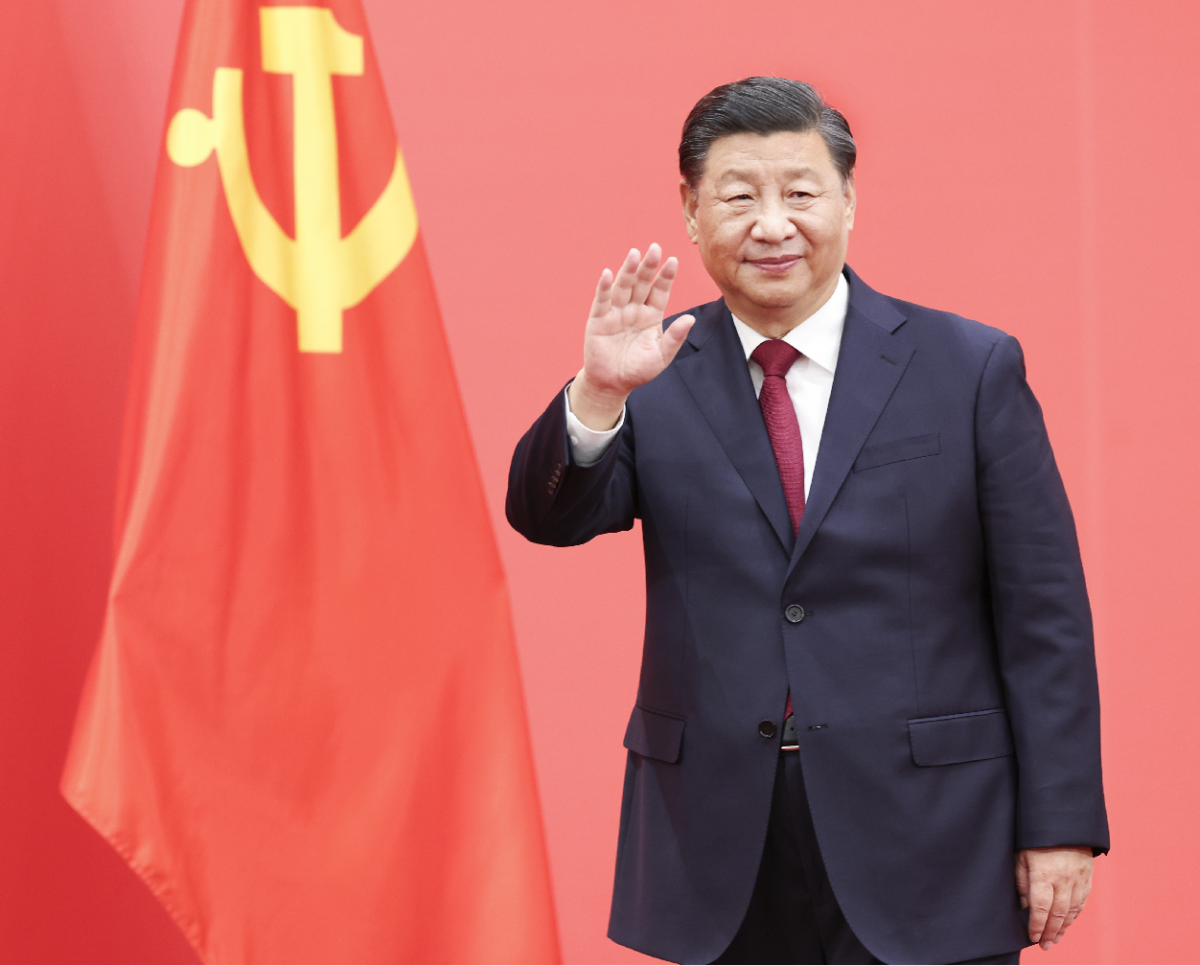
At the First Plenary Session of the 20th CPC Central Committee, Xi Jinping was elected to continue to serve as General Secretary of the CPC Central Committee. In a speech before the Chinese and foreign media, he said, "We are embarking on a new journey towards building a modern socialist country in all aspects, marching towards the second centenary goal and advancing the great rejuvenation of the Chinese nation on all fronts through a Chinese path to modernization."
In the 10 years since he became the General Secretary of the CPC Central Committee, China has undergone landmark changes, with the total economic volume jumping from 54 trillion yuan to 114 trillion yuan, winning the battle against poverty as scheduled, completing the historical task of building a moderately prosperous society in all aspects, and achieving the first 100-year goal.
As the core of the CPC Central Committee and the core of the whole Party, Xi Jinping shoulders a heavy responsibility. He has united and led the whole Party, the whole army and the whole nation to live up to the promise of the Chinese dream made 10 years ago, vigorously promoted reform, opening up and modernization, led the creation of a new era of socialism with Chinese characteristics, and led the irreversible historical process of achieving the great rejuvenation of the Chinese nation.
U.S. scholar Robert Kuhn, author of the book "How Chinese Leaders Think", said Xi Jinping has an objective and comprehensive understanding of China's national conditions and detailed and rational thinking about its future. Stephen Perry, president of the 48 Group Club in Britain, said that everything Xi does is driven by the people, which is crucial to China's development at this stage.
Samano Pholsena, former deputy general manager of the Lao National Electricity Company, who studied with Xi Jinping at the Bayi School in Beijing, said Xi Jinping does not do things for personal gain, but for the rejuvenation of the Chinese nation, and in the process benefits the world as well.
All the way from the yellow earth
"More than eight years have passed. The General Secretary's 'elder sister', called to my heart. When I think of it, I feel very warm." In November 2013, Xi Jinping came along a narrow mountain road to Hunan's Eighteen Caves Village and entered the home of villager Shi Basan. Shi Basan could not read or write, had never seen television, and did not know the Party's General Secretary. She asked, "How do I address you?" Xi Jinping took her hand and said, "I am the people's handyman." Learning that Shi Basan was 64 years old, Xi said, "You are my elder sister."
In October 2021, the estuary of the Yellow River in Dongying, Shandong Province. Xi Jinping walked into the field, leaned down to pick a pod, a handful of a twist, checked the color, put a soybean into his mouth, and chewed: "The beans grow well." The head of agronomy on the sidelines exclaimed: "Only an old farmer would make such a move!"
In the past 10 years, Xi Jinping has made about 100 visits to the grassroots, each time coming to the masses to talk to them and have a good natter. He paid a visit to the courier in the hutong, talked with the migrant workers at the construction site, discussed with the drivers at the taxi company the solution to the difficulty of taking a taxi for the holidays, and praised the sanitation workers as the "beauticians" of the city at the cleaning station...These words and actions reveal the General Secretary's heartfelt feelings for his people, who came all the way from the yellow earth.
Xi Jinping was born in June 1953 into a revolutionary family. His father, Xi Zhongxun, was a member of the older generation of proletarian revolutionaries in the Chinese Communist Party. Xi was deeply influenced by his father when he was a child. He later described his father as "an old bull, quietly plowing for the Chinese people"; "this also inspired me to devote my life to serving the people and to serve beautiful China and the folks who raised me".
Under the age of 16, Xi Jinping left Beijing, carrying with him a needle and thread bag embroidered with the words "Mother's Heart", which his mother had sewn together, and went to work in the rural areas of northern Shanxi province for seven years.
He called himself a peasant when he recalled this period of his life. He was far from his family, slept in a kiln, was bitten by fleas, herded sheep, cut grass, picked dung and hauled coal with villagers, enduring different hardships. Xi Jinping joined the Communist Party of China in Liangjiahe and became secretary of the brigade Party branch. His wish was to "feed the villagers with a meal of meat". He led the villagers to build wells, silting dams, terraces and biogas ponds. After a year, the situation of villagers not having enough to eat and fleeing from the famine no longer existed.
When Xi visited Costa Rica in 2013 and was a guest in a farmer's home, he particularly mentioned his experience as a farmer. "Few national leaders would be proud of the fact that they were once farmers." Alberto, the son of the farmer's owner, said, "Other leaders might not mention that experience, but Xi Jinping is not like that."
Hard life in the countryside made Xi Jinping extraordinarily treasure food. After becoming General Secretary of the CPC Central Committee, he repeatedly issued instructions on "waste on the tip of the tongue" and called for the "empty plate operation". He repeatedly advised the Chinese people to keep their rice bowls "firmly in their own hands".
Xi Jinping said that his understanding of the word "people" came from his feelings when he was stationed in northern Shannxi province. The idea of serving the people has been a part of his political career. After graduating from college in the late 1970s, Xi joined the General Office of the Central Military Commission as secretary to the Minister of National Defense, and three years later he volunteered to work at the grassroots level in the impoverished Zhengding County in Hebei Province. His wife, Peng Liyuan, recalls that many of his classmates went abroad to make money, and it's not that he didn't have the conditions to go out, but he chose a more difficult path, the path of being a servant of the people.
During his three years in Zhengding, Xi Jinping rode his bicycle throughout the county's 25 communes and more than 220 brigades. Sometimes, he went to the countryside to visit just in time for the villagers to hoe the ground and plant seedlings. Xi Jinping rolled up his sleeves and picked up a hoe to work with the villagers. He also gave the county committee's jeep to the reporter to sit. He said, "The reporter has a tight schedule, a heavy task, many places to run, and a long way to run."
After that, he went to Xiamen, Fujian Province, on the coast to be the vice mayor. He bought a "Wuyi" bicycle and rode it with his staff to the streets of the community or to the factories for research. Xi then moved to the Ningde area as secretary of the local party committee. He took his cadres to the poor township of Xiadang for research, and when there was no road, they used knives to cut down the weeds and walk across. When he saw that the farmers were poor, Xi Jinping gave them his own money. He built roads and hydropower stations for the township, showing the way out of poverty.
In Zhengding, he visited all the villages; in Ningde, he visited 9 counties within 3 months of his arrival, and later visited most of the townships; after his arrival in Zhejiang, he spent more than a year visiting 90 counties and urban areas in the province; in Shanghai, he visited 19 districts and counties in the city within 7 months; and after his appointment as General Secretary, he covered 31 provinces, autonomous regions, and municipalities, as well as the two special administrative regions of Hong Kong and Macao. He repeatedly quoted Mao Zedong's famous words, "No investigation, no right to speak," emphasizing that cadres should master the "basic skills" of grassroots research.
At the end of December 2012, a month after his appointment as General Secretary, Xi Jinping walked into the home of a poor family in Fuping, Hebei province, and sat cross-legged on the bed, holding hands with the villagers and asking them in detail about their living conditions. On this trip, he issued a mobilization order to the whole party and the whole country to fight poverty. Two months before the 20th Congress of the Communist Party of China, Xi Jinping walked into a renovated old neighborhood in Shenyang, Liaoning Province, to care about the daily life of residents.
Xi Jinping worked in Fujian for 17 and a half years. In the land of beautiful mountains and clear water, his emotion for nature was further sublimated. Once when he visited Shangqing Creek in Taining County, a red carp jumped onto a bamboo raft, and the rowers said they were blessed with a mouthful. Xi took off his shoe covers, filled them with water, put the carp in, released it in a safe place downstream in deep water, and told his colleagues to "take care of the environment". After he became General Secretary, he turned the assertion that "clear waters and green mountains are as valuable as mountains of gold and silver" made during his tenure as Secretary of the CPC Zhejiang Provincial Party Committee into an unprecedented scale of national ecological civilization construction action.
He continued the "visiting system" he created in Fujian after he became the Secretary of the Shanghai Municipal Committee of the CPC. 2007 was the year when many conflicts in Shanghai were highlighted, such as the issue of relocation, the conversion of enterprises, and the distribution of rural land and collective assets, all of which were difficult problems. Xi Jinping proposed that leading cadres should go around the city. Some people were worried about "getting into trouble," but Xi Jinping was adamant, saying, "I've visited around Zhejiang, and I've encountered big scenes with thousands of people, so there's nothing to be afraid of."
Xi Jinping continued to carry on his pro-people nature after he came to work in the central government. On the eve of every Spring Festival, he visited the homes of the people to send holiday greetings. His early experiences of starvation and farming in the countryside may explain why he almost always lifted the lids of pots and pans, inspected cellars, touched firewalls and looked at toilets in the homes of the villagers. He also frequently keeps in touch with the people by correspondence, from large grain farmers to private entrepreneurs, from elementary school students in the old revolutionary areas to young scholars returning from their studies abroad, from members of the Ulanmu Riding to border guards and soldiers.
He made the decision to deploy targeted poverty alleviation in 2013, sending 255,000 village-based task forces and more than 3 million first secretaries and village-based cadres to rural areas to help poor farmers on a peer-to-peer basis. According to Kuhn, Xi's leadership and determination to deliver on his promise to fight poverty is one of the main reasons for China's success in fighting poverty.
Real men do not easily cry, but Xi Jinping sheds tears for the people. In 1966, his junior high school teacher read aloud in class "The example of county party secretary - Jiao Yulu", and Xi Jinping listened with tears streaming down his face. "Whether I later went to the mountains and the countryside, went to college, joined the army, or did leadership work, the image of Comrade Jiao Yulu has always been in my heart." Xi Jinping said. He also recalled, "The moment when I said goodbye to Liangjiahe Village was one of the most memorable events of the internment, and that time was crying in public." In 2015, Xi Jinping returned to Liangjiahe Village, bringing his own money to buy "New Year's goods" to pay tribute to the villagers.
Sharing the hardships of the people has helped Xi Jinping to consolidate and deepen the ideals and beliefs he had when he joined the Party. He summed it up as: working for the happiness of the people and the rejuvenation of the nation. In the past 10 years, he has initiated five centralized party education sessions, asking party members to "not forget the original intention and remember the mission".
When Xi was young, his mother, Qi Xin, told him the story of Yue Fei's "serving the country with fidelity. "I remember the words 'serve the country with fidelity' from that time until now, and it is also the goal I have pursued all my life." He said.
Xi understands the suffering of China a century ago, describing it as "a scene of decay and withering". In 2018, he climbed the fort site during a visit to Liu Gong Island in Shandong Province and pondered for a long time facing the Yellow Sea. At the Sino-Japanese War Museum, he recited Wen Yiduo's "Song of the Seven Sons - Weihaiwei" in its entirety. This small island of less than 4 square kilometers witnessed the destruction of the Qing Dynasty's Beiyang Navy, which was known as the "First in the Far East" more than a century ago, and its defeat forced the Qing government to cede Taiwan and pay huge amounts of money to Japan.
Xi Jinping, the first General Secretary of the Communist Party of China (CPC) Central Committee who was born in the People's Republic China, has felt the pride of the Republic's "standing up" - the victory in the fight against the US and aid North Korea, the establishment of a relatively complete industrial system, the creation of the "two bombs and one star"...... He praised these achievements, saying that "only socialism can save China, and only socialism can develop China".
Xi Jinping was passionately committed to reform and opening up. From the relatively backward inland to the developed coast, he was a leader in attracting investment, promoting foreign trade and fostering the common development of multi-ownership economy. Xi Jinping worked in Fuzhou during the period when the most Taiwanese and foreign-invested enterprises were introduced there. In Zhejiang, he supported the development of private enterprises and asked people to learn from the hard-working spirit of private entrepreneurs. After becoming general secretary, Xi hosted a forum on private enterprises. He said, "private enterprises and private entrepreneurs are our own people", "China's private economy can only grow and cannot be weakened".
He is good at thinking from a pragmatic and long-term strategic perspective. In Fuzhou, he proposed the "3820" project and asked for "immediate action and real work". His "Eight-eight Strategies" are still the guide for the development of Zhejiang Province. He advocated the construction of "digital Fujian" and "digital Zhejiang" early on, putting an information engine on regional development. "He always foresaw the economic situation in the longer-term future." Wang Jing, a private entrepreneur in Fujian, said.
In 2020, Xi Jinping led the drafting of a proposal by the CPC Central Committee on the formulation of the 14th Five-Year Plan and the 2035 Visionary Goals, which provides a systematic plan for China's long-term development. To do a good job of planning, he hosted several symposiums to listen to the opinions and suggestions of entrepreneurs, scientists, grassroots representatives and other parties, and instructed to conduct online consultation. Internet users participated enthusiastically, leaving more than 1 million messages, from which the parties concerned compiled more than 1,000 suggestions.
During his tenure as Secretary of the Shanghai Municipal Committee and Vice President of the State Council, Xi Jinping participated in the preparation of the World Expo, which attracted more than 73 million visitors from home and abroad with the participation of 246 countries and international organizations. After becoming General Secretary, Xi Jinping initiated the establishment of the world's first import-themed national exhibition, the China International Import Expo. He has promoted the formation of a national "exhibition matrix" including the China Import and Export Fair, the Trade Fair for Services, the Consumer Expo and the Canton Fair, to expand the opening up of the world and meet the growing demand of Chinese consumers for a better life.
During Xi Jinping's decade as General Secretary, the wealth of the populace has increased. China's disposable income per capita in 2021 was 35,128 yuan, rising over 80% from 2012. The ratio between urban and rural people' incomes decreased to 2.5:1.
In the words of Xi Jinping, everything he does is "people-oriented". In his self-described essay "I am the son of the yellow earth," he wrote: "Love the people as you love your own parents, work for their interests, and lead them to a good life." After he became general secretary in 2012, he said, "The people's aspiration for a better life is our goal of struggle." After being elected General Secretary at the First Plenary Session of the 20th CPC Central Committee, he said, "The people will always be our most solid support and strongest backbone," and "We must always be with the people through thick and thin, and with the people at heart."
Xi Jinping has a very high "popularity" among the people. Some old mountain village supporters gave him a thumbs up and praised him to his face: "You, you're doing a good job!" Young people drew "pro-people image cartoons" for him online. A survey by Harvard University's Kennedy School of Government shows that the Chinese people are 93 percent satisfied with the Chinese government under the Party's leadership. According to a report released by Edelman, a leading global PR consultancy, Chinese people's trust in the government reached 91% in 2021, ranking first in the world.




Comment