






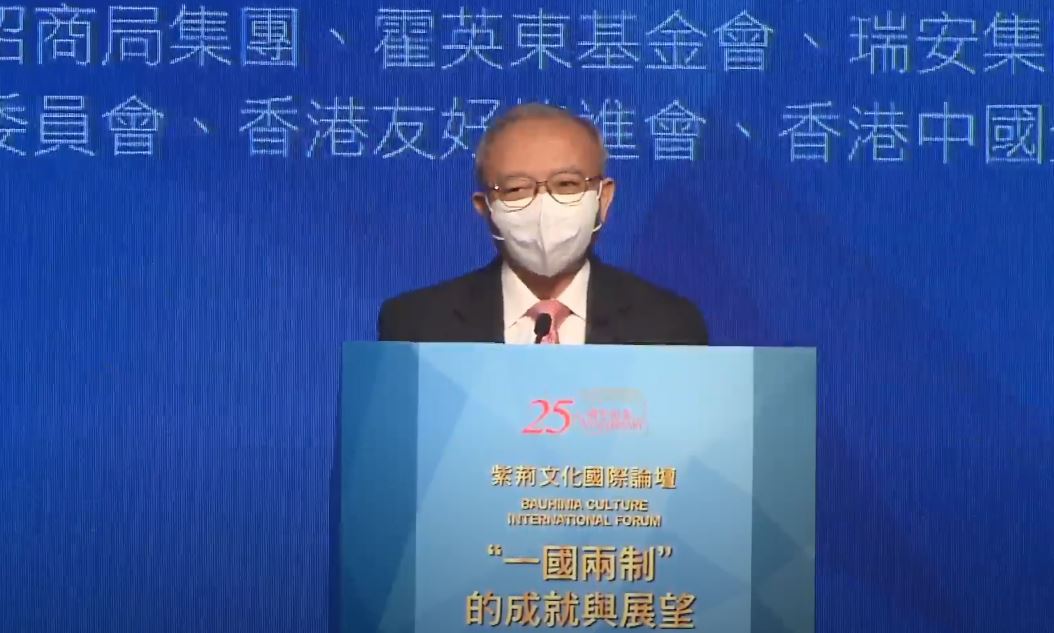
By Lau Siu-kai
"One country, two systems" (OCTS) is a primary, practical, and wise national policy devised by Beijing (the central authorities) to achieve the nation's peaceful reunification and maintain Hong Kong's prosperity and stability after its return to the motherland. Even though Beijing, having sovereignty over Hong Kong, enjoys comprehensive jurisdiction over the city, Hong Kong however is delegated wide-ranging powers to enable it to exercise a high degree of autonomy. Understandably and naturally, Beijing still retains a batch of constitutional powers, coming from the national constitution and the Basic Law, to ensure, inter alia, that national security is protected, OCTS in Hong Kong is comprehensively and accurately practiced, the Basic Law is correctly interpreted and executed, the political institutions of Hong Kong are compatible with the needs and purposes of OCTS, and the Chief Executive and principal officials are fully accountable to the central government.
In retrospect, the success of OCTS in Hong Kong owes immensely to Beijing's faithful and impeccable fulfillment of its obligations under OCTS and the prudent exercise of its constitutional powers. Arguably, since Beijing bears ultimate and inescapable responsibility for the success of OCTS, the powers are exercised mainly to fulfill its solemn obligations to the nation and Hong Kong.
All along, Beijing is determined and sincere in fulfilling its obligations under OCTS. Beijing, for example, has, in conformity with the Sino-British Joint Declaration, stipulated "the basic policies of the People's Republic of China regarding Hong Kong and the elaboration of them in Annex I to [the] Joint Declaration in a Basic Law of the Hong Kong Special Administrative Region of the People's Republic of China, by the National People's Republic of China, and they will remain unchanged for 50 years." It should be noted that Beijing's basic policies toward Hong Kong were made by Beijing alone and had nothing to do with Britain. The promulgation of the Basic Law in April 1990, which goes further than Annex I in conferring rights and privileges to the Hong Kong residents, undeniably demonstrates that China has completely fulfilled her obligations under the Joint Declaration, and thereafter the Joint Declaration has become a historical document without legal effect.
Over the years and until recently, Beijing had been very cautious, restrained, and conscientious in using its constitutional powers. Beijing exercised tremendous patience and displayed much magnanimity in face of the relentless provocations and assaults by the "anti-China" elements in Hong Kong and their foreign patrons. The Standing Committee of the National People's Congress, while aware of and worried about widespread misunderstanding and deliberate misinterpretation of the Basic Law in Hong Kong, even among lawyers and judges, had only "reluctantly" interpreted the Basic Law five times after other means to settle the crucial controversies over the Basic Law were exhausted. While Beijing's interpretations of the Basic Law had drawn a lot of fire from the "anti-China" forces, they were by and large seen by many Hong Kong residents as Beijing stepping forward to resolve Hong Kong's difficulties. The most notable instance took place in 1999 when Beijing interpreted the articles in the Basic Law about the right of abode, overturned the Court of Final Appeal's interpretation, and averted a massive influx of mainland residents into Hong Kong. Since constitutionally Beijing is the ultimate authority in the interpretation of the Basic Law, its self-restraint in exercising the power of interpretation showed that Beijing was determined not to be criticized as overbearing or as trying to serve political ends through legal means.
To maintain political stability in Hong Kong and to reassure the hypersensitive Hong Kong residents, Beijing decided to transfer the responsibility to enact laws to safeguard national security, a responsibility commonly borne by the central government, to Hong Kong. Beijing is fully aware and naturally nervous about the adverse consequences of such a decision given the openness and "porousness" of the Hong Kong society and the presence of numerous antagonistic foreign forces and their local agents in the city. What happened subsequently in Hong Kong was that Article 23 of the Basic Law, which is about safeguarding national security, had failed to be locally enacted because of the obstruction of the political opposition and their followers. Even so, Beijing had no intention to "claw back" from Hong Kong the privilege of making local laws to protect national security, thus leaving many lacunas in the national security legislation in Hong Kong and making the city a potential source of national security threat.
During the transitional period before Hong Kong's return to the motherland, the departing colonial government had unilaterally introduced, without consulting Beijing and obtaining its approval, elections for the legislature, part of it was even popularly elected. The British purported to enable the "anti-China" forces in Hong Kong to enter the legislature and to build up a mass base. While Beijing was able to reverse some of the electoral arrangements afterward, still the "anti-China" elements in the legislature were allowed to stay because of the lack of a robust political screening mechanism. Though in a minority position, the "anti-China" legislators were able to deploy a lot of obstructionist tactics to make the life of the Hong Kong government difficult and render effective governance impossible. Such a strained executive-legislative relationship ran afoul of the legislative intentions of the Basic Law, as the Basic Law drafters back in the late 1980s were earnestly calling for a cooperative relationship between the two bodies. Though owning the constitutional power to establish and change Hong Kong's political institutions, Beijing, concerned about possible political repercussions, did not see fit to reshape Hong Kong's electoral system. Instead, Beijing hoped that the "anti-China" opposition would eventually see the light and abandon their confrontational stance toward Beijing.
Regrettably, Beijing's goodwill, forbearance, and self-discipline were not reciprocated and instead were misunderstood as signs of weakness and timidity by a lot of Hong Kong residents, particularly by the political opposition. The "anti-China" forces spared no effort to stir up anti-communist, "anti-China", and anti-government fervor among the Hong Kong residents, mobilizing and organizing them into interminable protest actions. They shrewdly manipulated the issue of "political reform" and succeeded in perennially putting it at the top of the public agenda, amassing substantial political capital in the process. Their final goal was to seize more and more political power and, hopefully, with Beijing's tacit and reluctant approval, gain the right and power to run Hong Kong.
All these dire political developments in Hong Kong came to a head in the past decade, the "Occupy Central" protest and the 2019-2020 insurrection being the most glaring examples of Hong Kong on the precipice. The protestors had become increasingly radical both in rhetoric and tactics. Various forms of separatism and localism were advocated, the most pernicious being the call for Hong Kong independence. The constitutional order, made up of the national constitution and the Basic Law, was rejected, defied, and trampled upon. Violence prevailed and law violations abounded. Society was sharply divided and politicized. The disintegration of the political order made day-to-day governance extremely difficult. Most threatening was that the external forces, particularly those from the West and Taiwan, were deeply implicated in Hong Kong's unprecedented turmoil. All of these happened in the context of deficiencies in national security legislation in Hong Kong and intensifying all-out containment of a rising China by the United States and its allies. In these grim circumstances, not only was national security under serious threat but the viability and the future of OCTS were hanging in the balance.
The Hong Kong government was no match for the coalition of internal and external hostile forces. Beijing had to act quickly, decisively, and powerfully. Hong Kong and OCTS could only be rescued by the forceful exercise of the constitutional powers of Beijing. Beijing thus moved speedily to pass the Hong Kong National Security Law and drastically revamp the electoral system of Hong Kong. Very quickly the insurrection was suppressed, and the "anti-China" forces vanquished. The actions of Beijing were authorized by both the national constitution and the Basic Law and in line with the principle of Beijing being the ultimate guardian of national security and the OCTS. Fortunately for Hong Kong and the nation, notwithstanding the granting of a high degree of autonomy to Hong Kong, Beijing has never given up the prerogatives of legislating for Hong Kong via national laws and deciding on Hong Kong's political institutions.
Since Hong Kong's return to the motherland, Hong Kong has gone through many big and small crises. In most crises, Beijing prefers to take a hand-off stance, abiding strictly and faithfully by the principle of respecting Hong Kong's high degree of autonomy. Nevertheless, Deng Xiaoping was sagacious to foresee back in the 1980s that in some cases Beijing had to intervene because Hong Kong could not solve the problems on its own. Therefore, said Deng, having Beijing holding on to some constitutional powers would benefit both Hong Kong and the nation.
From the perspective of the implementation of OCTS, the crises in Hong Kong in the last several years testify vividly that the retention of some constitutional powers in the hands of Beijing is critical not only to the comprehensive and accurate implementation of OCTS but also to its survival under some circumstances. The powers at the disposal of Beijing will not only not undermine Hong Kong's autonomy but instead will strengthen its autonomy against the onslaught from internal and external hostile forces.
Despite the inexorable demise of the "anti-China" forces in Hong Kong, external forces such as the United States and the West are expected to persist in their adversarial stance toward China and Hong Kong. National security and Hong Kong's stability will continue to be under serious threat. The active but prudent exercise of Beijing's constitutional powers over Hong Kong is necessary to protect OCTS and prevent Hong Kong from becoming a base of subversion. Unavoidably, Beijing's legitimate and indispensable participation in Hong Kong affairs has been "denounced" by critics with ulterior motives as undermining Hong Kong's autonomy. Still, in the days ahead, it is obvious that only with Beijing's constitutional powers and the powers delegated to Hong Kong working in tandem can the success of OCTS be fully guaranteed.
(Source: Bauhinia Culture Group)




Comment